Folsum Manor Blues

HeightsI hear Heathcliff a’wuthering; he’s wuthering on the heights,
and when he gets all angry, he gives me such a fright…
I’m stuck in a 19th Century Novel, and time keeps dragging on;
my only consolation: at least it’s not Uncle Tom.

When I was just a baby, my mother told me, Son:
always be a good boy, and not Dickensian,
But I’m stuck inside this workhouse,  I know I can’t be free;
eventually I’ll die of consumption,  what you might call TB.

There’s austentatious Gentry in their fancy country homes,
engaged in bright conversation, eating clotted creme with scones,
I’m stuck here in this Novel, like Marner at his loom,
Comedies of manner, voiced in proper decorum.

If I was free from this Novel, if the story it was mine,
I’d choose one with a plot-line, not quite as serpentine…
Far from 19th Century Literature, that’s where I’d like to stay,
and I’d let the 21st Century

….lose me in the buzz of fractured time and multiple perspectives.

Why should humans be moral?

My dear Emilee,
You asked me “Why should humans be moral?”
That is a really big question. It is also a very important question, and one which can open the door to long conversations and many more questions.Hello Questions
However, the question is phrased in such a way that makes it difficult, almost impossible to answer, and in such a way that always leaves a little gap of doubt. Why be moral implies that goodness–kindness and courage and honesty and generosity and whatever other moral words we humans use–are separate from us, alien to us, almost like a remarkably fancy yet highly impractical (and, need I mention, very costly) fedora which we can choose to put on our heads or choose to leave in the front window of the Haberdashery in State Street.
Morality is best not a noun, but an adjective describing humans, or even an adverb describing how humans are human. I would really prefer not to use the word “moral, ” but instead to ask “Why should humans be good?”

Of course, I really prefer to ask “why should humans be good?” because it is an absurd question. Good is desirable. Why should food be good? Because good food is–by definition–better than bad food. Why eat bad bread? Why should music be good? Why should I try to make this a good answer? Although trite, it is quite simply the case that goodness is good. A human being doesn’t desire to be a not good human being; if it is within our power, we are as unlikely to deliberately choose not to be good as we are to choose to be hideous, or even choose to be uncoordinated or unpopular.

Goodness is good, but we certainly do get sidetracked.
There is within most of us–within everybody I’ve met, and I have met many, many people from all the hemispheres & continents–a desire to be good, and generally, some sort of moral sense that suggests what that goodness might be. I am under no illusions that we actually are good–a day or two working retail or being a barista will show you that humans are capable of being saints and fiends and everything in between–but they each want to understand themselves as good, and be understood as good, and judge others as good or evil.

Yes, there are sociopaths, but they are exceptional, not typical (albeit amazingly common any place that serves espresso drinks).

Yes–and this is not at all exceptional–we often ignore the desire to be good. We human beings want to take shortcuts, and we want to taste forbidden fruit. “Yes, I want to be good, but it would be so much easier to tell a lie than to deal with this right now.” “Yes, I desire to be good, but I also desire the feel of her soft skin warm against mine.”

Yes, there are many different ideas of what it means to be a good person. There are disagreements within cultures, and there are incommensurable differences across cultural lines, but underneath these there is a desire to be good. In fact, one of the reasons the disagreements are so ferocious is how strongly we feel about being good.
We want to be good, and we want to be thought good. We don’t want our friends, our families, our acquaintances, or even total strangers to think we are a louse, a jerk, a letch, a cheapskate our mooch, a liar, a coward, and insensitive lout or a douche-bag. We want them to think we are a good person, in part because ultimately that is the only way we can know ourselves to be good. Sometimes we internalize the judgements of the world to create an interior judge, but we also externalize our own conscience, looking for concurring second opinions.

So, my dear young friend, my long-limbed albatross flying across the seas, my dear Emilee, my answer is, in short:
There is no Why should humans be moral. Morality, like rationality, like bipedality, like fondness for sugar and salt and fat, is part of human being.

The vital question isn’t why, but how?

…and that leads to a whole mess of new questions and conversations.Menu

Why eat bad bread?

Basic Wholesome Wheat Bread RecipeWholesome_Wheat_Bread.

 Ingredients: 

3 1/2 cups warm water
2 Tbsp. Honey
2 Tbsp. Yeast (maybe 3 envelopes?)
1Tbsp. Salt
8-9 cups, give or take, of whole wheat (3 cups) and bread flour (6+ cups); Yeah, yeah, I don’t have an exact amount because there isn’t an exact amount–I live in a very humid, even damp, part of the country, if you are actually dry, you will need less flour. Using more whloe wheat will also require less wheat overall. I really, really love King Arthur Flour, and start with 2 cups of King Arthur Whole Wheat, then 2 Cups of King Arthur White Wheat, and then 5 or more cups of King Arthur Bread Flour, but you go with what you have.

Step 1, Proofing: In a large bowl (or the mixer bowl if you plan on letting the bread hook to the heavy lifting); whisk in the 2 Tbsp. of Honey, and the 2 Tbsp. of Yeast; mix until smooth. Whisk in the first 3 cups of flour–I usually move from the coarsest flour to the smoothest, so the wheat flour here. Now leave this in a warm place for 5 minutes and walk away. Fold laundry, try to figure out where you put the bread flour, dance, just leave the yeast alone.
Step 2, Kneading: Come back, Little Sheba. If it is bigger, and a little poofy, the yeast is doing great. If not, either you have bad yeast or a cold spot. Whisk down this living thing in the bowl, and add 1 Tbsp of Salt. Add in the Bread Flour 1/4 of a cup at a time, and thoroughly mix it in; when the whisk becomes impractical, use a big wooden spoon, when this is too hard, use a mixer with a bread hook or turn it our onto a floured surface. It is important to knead the flour in 1/4 of a cup at a time, and after each bit of flour, hook or knead the bread until it becomes one thing again–not a mixture of flour and dough, but one unit. When the dough is a single round thing holding on to itself and not sticking to other things, behaving about like a deflated volley ball, it is ready. The amount of the flour doesn’t matter–getting it to this proper consistency is what matters. Roll it around on the counter for good measure.
Step 3, Rising: Grease a smooth bowl 3 times as big as the dough. Roll the dough ball in the oil, and then cover with plastic wrap or a wet towel or something that will let it slip without drying out. Let this sit in in a warm place–in the oven with a heating pad on a different shelf, on the sunny side of the house, just a safe and warm place–until the dough has doubled in size. Usually, this will be about an hour.
Step 4, Second Rising: Grease 3 bread pans, or 2 bread pans and 2 little pans, or some such combinations. Turn the dough out onto a clean surface, and punch it down (forcefully knead it), which should reduce it to close to its original size. Separate this into 3 portions ( or 4 or… you figure it out) and shape these into loaves; make sure that there are not seams or spots the loaf might separate, maybe pinching loose edges and rolling it about a bit–each should be smooth and coherent–it’s own little self. Put each loaf into a pan, slit along the top with a sharp knife (this lets bubbles out) and set these into a warm place until they have grown–usually less that the first rise. about half way through this rise (20? 25 minutes?) pre-heat the oven to 400 degrees.
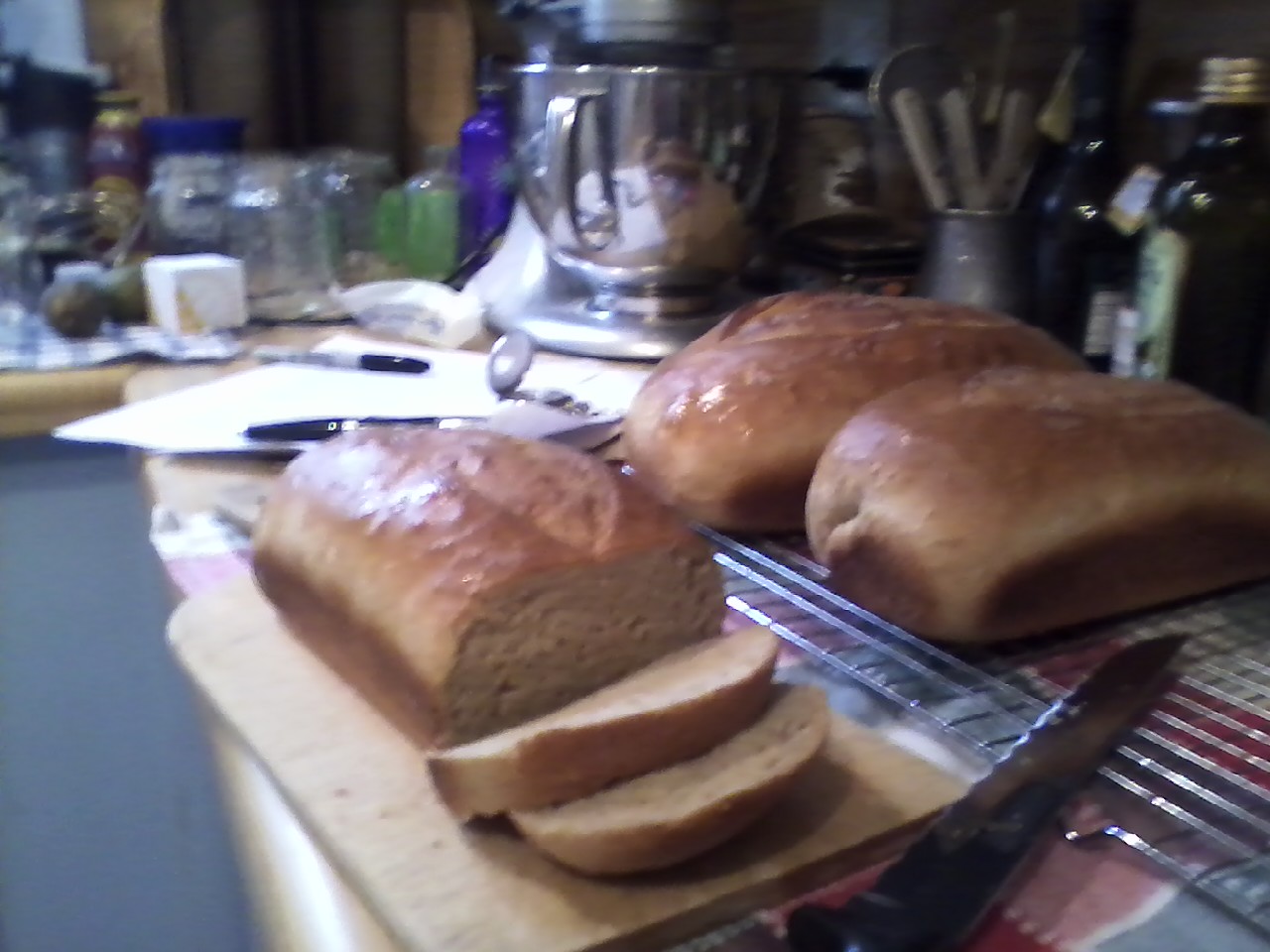
Step 5, Baking: put them in the oven for 30 or 35 minutes, until the top crust is a nice dark brown. figure out your oven, and see if you need to turn them or rotate them to get them to cook evenly. When they are done, get them out, take them out of the pans, and put them on a cooling rack. Usually, at this point, I take a little butter and polish the top with them, but one doesn’t have to.

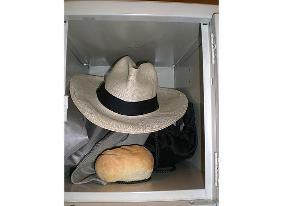
The Philosopher's lockerLast Step, Sharing: You may have noticed I made 3 loaves. You can, of course, use division and figure out how to make a smaller batch, but I suggest you make 3, and then figure out why you needed 3. The bread might be so good that one loaf is eaten before it even cools. Most importantly, if you have extra bread, you will have to give it away. Give it to a wandering Buddhist monk, a musician or a college student–all of these are good karma. You might give some to somebody you love, or whom you wish to love, or who needs to feel loved. My mom says it is just as easy to pray for somebody while kneading bread as it is just to pray for somebody; I don’t understand prayer, but I know everybody needs to feel loved and everybody loves good bread.

Note: this recipe is adapted from Family Fun’s Family Cookbook. I know, it’s Disney, but it is a great cookbook.

If you have a question, leave a question; if you need a question, take a question.

Pilosophy BistroSo, as I get started, are there any questions anybody would like to throw out?
Giedra: Here are my questions, as someone who never studied philosophy:  What misconceptions do decently educated people have about philosophy/particular lines of philosophical thought/particular philosophers?  What aspects of philosophy, if any, do you wish were more widely known/understood, and why?  What are the differences/similarities between philosophy and theology?  
Sarah: How can I get my mom to remember that her great-grandson’s name is that–Soren–and not Borst?
Jerri: I would like to hear your thoughts about why American culture vilifies intelligence and critical thinking.
Grace: What about Germany? How did it shape you, what reminds you of it, what was it like growing up there? Also: Existentialism vs Nihilism? Why does wandering make you feel less lost?
Melissa: How do you make bread from scratch?
Ben: Is there a correlation between Western society’s increased individualism, And their decreased threshold for discomfort, pain and suffering?
Abby: What’s for dinner when your fridge currently holds eggs, bacon, zucchini, and three kinds of cheese (and the zucchini needs to be used or tossed)?
Emilee: Why should humans be good?

shoes and books

I was listening to Richard Blanco’s Inaugural Poem today, and was struck by the following line:

“hands as worn as my father’s cutting sugarcane
so my brother and I could have books and shoes.”

ShoesSo much of your childhood I spent working
and missing you;
in classes I taught, phones I answered, files I sorted, keys labelled and given, customers I greeted and smiled to again and again and again.
Wondering, all the while, what story you might be telling if I was there.

But I had to work.
I had to work to buy you the things you would need,
Things like books and shoes.

Books to take you to whole new worlds,Books
and shoes to take you across this one;
books to feed you on dreams,
and shoes to walk towards them.

I have been a father,
and I have given you books and shoes and love.
Books and shoes to take you far from me,
and love to keep you always near.