Shameless Plug
Image

The Philosophy Bistro is a leader in the “slow thought” movement.
If you have read Daniel Kahneman’s Thinking, Fast and Slow, let me give it a plug here: it’s a fun and educational read for anyone interested in how the human mind works. Kahneman’s main innovation (in collaboration with his research partner Amos Tversky) was to show that normal human beings are vastly more irrational than was previously thought. Into the 1970s, social scientists – and not just economists – still assumed that under standard conditions, most adults acted rationally most of the time. Through a series of clever experiments, Kahneman and Tversky demonstrated that this is far from the case. Here’s one example.
Imagine that Bruce Springsteen is coming to your town. (Odds are good that this is true.) And let’s say that you consider going. You think about how much you’re willing to pay for tickets, and decide that you’d spend $20 for a seat. This is simply a quantification of your preference. You’d rather listen to “Blinding By the Light” live than have that $20 still in your pocket. That is the current value of that experience to you.
But later that day you’re listening to the radio and the station’s having a contest and giving away a free ticket to tomorrow’s Springsteen concert to the winner. You pull over (do pull over, please), call in, and give the correct answer to the question, “What are the names of all of the US state capitals west of Los Angeles, California?” (Answer at bottom of this post.) Congratulations! You’re the proud new owner of a free ticket to see Bruce. You drive right over to the stadium to pick it up.
And then you lose it. That’s what you get for having lunch at Denny’s. Those scrambles take up the whole table. You shouldn’t have had the ticket out in the first place, but it was so fun to show off. (Next time, come to the Bistro instead.) But you still want to go to the concert. And you were thinking about buying a ticket anyway. So, you check the prices again. But they’ve gone up. They must be selling out, and the venue’s trying to maximize their take as they supply dwindles. Are you willing to pay more than $20 to get your lost ticket back?
If you were a purely rational being, your answer should be, “No.” The same ticket was worth $20 to you earlier in the day. It ought to still be worth $20 to you now. But this is where what Kahneman and Tversky termed “loss aversion” comes in. The threat of losing something we already have makes us value it higher. The typical “loss premium” in their experiments came out to about 50%. That is, if you’re like most people, you would pay up to $30 to get back the ticket you lost, even though you would have only been willing to pay $20 for it to begin with.
This is a bug built into our systems, and it causes trouble. I used to see it working on space issues at colleges. Office shuffles could be maddeningly difficult because (a) professors had greater veto power than employees usually do, so you needed at least their tacit approval, and (b) that approval was hard to get because almost nobody was willing to give anything they valued up, at least easily. You could show someone her new office, which was nicer than her current space in every way that mattered to her – including the nice windows and its location near her colleagues and the cafeteria, but just enough off the main drag to provide a little quiet. But if it was 20 square feet smaller than her old office, she likely wouldn’t want to make the trade. Time and again, these discussions would ignore all the large gains and focus almost entirely on the small loss. I occasionally became frustrated because I was sure that the person I was working with was having trouble making a decision that would make them more satisfied in the long run because it felt so bad to give anything up. Many of these situations worked out eventually. Some didn’t. That’s life with loss aversion. And though I find it easier to see in others than in myself, I know I suffer from it too.
Things are even worse than I’ve made it sound, though, according to Kahneman. I’ve just given one example of human irrationality. His book is full of dozens, which he deploys to argue that mind can be thought of as two systems, which he terms simply “system 1” and “system 2.” Because the Bistro is a Philosophical venue, I’m going to ignore Kahneman’s cautions against reifying and romanticizing these systems (What else is Philosophy for?) and call them “the intuitive self” and “the reflective self.” The intuitive self is the one that acts instantly. It’s the you that reacts to an oncoming car by steering out of the way more quickly than your more deliberative decision-making process could function. The reflective self, meanwhile, is the one that thinks situations through in detail, that focuses intently, that calculates. So far, so good.
Here’s the thing: Your reflective self thinks it’s the one in charge. As the Civil War-era saying goes, “There’s nothing so like a god on earth than a general on a battlefield,” and that’s the way the reflective you thinks about itself. And why not? It’s so good at coming up with persuasive explanations for your behavior. But that’s part of the problem, as another Kahneman experiment demonstrated. They flashed participants a series of paired pictures, which they had them rate by comparative attractiveness. (Here’s one face. Here’s another. Which one was better looking?) The participants only got a glance, so this was their intuitive self at work. After they said “The first” or “The second,” the experimenter brought the preferred picture back out and asked why it was more attractive than the other one. With the added time, the reflective selves had no problem coming up with elaborate account of all the reasons for their choices. And at first glance this looks like a moment of harmony between the two systems: the intuitive self decides, the reflective self explains. It’s a perfect division of labor.
But it’s a sham. Or at least it can be. You see, half the time the experimenters brought back out the picture the participant hadn’t selected. (That is, the participant said, “The first picture is better looking,” and the experiment pulled back out the second one.) In most instances the participant did not catch the switch. (If this seems unlikely, click here.) And in those instances they had no trouble explaining their “choice”. That’s the big finding: your reflective self can make a case for a decision you didn’t make just as easily as it can for one you did. That’s not reasoning, that’s rationalizing. The reflective you isn’t the general it thinks it is. It’s a lawyer.
That’s what lawyers do, after all. Within certain broad boundaries, they aren’t expected to pursue the truth of the matter; they’re expected to give you the best chance to win. That’s why they say such ridiculous things sometimes. A lawyer is someone who will say, “I didn’t do it; and if I did to it, I had a very good reason.” (This is what trips up Thomas More with the jury in Wolf Hall.) Most of us have trouble being quite so mercenary about our relationship with the truth, at least in public. We expect others to expect us to say whether we did it or not, full stop. But a good defense attorney doesn’t want to make things that easy for the prosecution. His goal isn’t to uncover what happened, it’s to keep his client out of jail. And with the least bit of cover that everyday life away from courtrooms tends to provide us, that’s the approach most of us take most of the time. Unless we put the extra effort in, our natural inclination is to explain events to ourselves and others in ways that put us in the best possible light.
At least that’s what Kahneman’s work suggests. And though I don’t mean to be a complete cynic, I am inclined to agree. We’re capable of better. Often we do better. But without deliberate and skilled effort, this is our fate: to live with half the mind of a lawyer. And that’s a bit of a shame, given that we generally don’t think that much of those who have the whole thing. (Note: I kid because I love. When your father, brother, and wife are all lawyers, you hear a lot of lawyer jokes.)
Let me close with a question: Maybe your mind is neither a general nor a lawyer; so what is it?
Photo credit: Farrar, Straus and Giroux
Answer to radio call in question: Honolulu, Juneau, Olympia, Salem, Sacramento, and Carson City. (The California coast tends dramatically east around Santa Barbara, much more than your mind’s eye would probably lead you to believe. People who got the correct answer can redeem their Springsteen ticket here.)
 As anybody who follows my cooking knows, I am always up for trying something new. I also wonder if, in spite of the biographies on the “About the Bistro” page, some of my readers might be unfamiliar with the staff.
I thought we might have this week’s feature as a panel discussion.
Recently, Andy—long-time friend of the Bistro—
It seems like the Bistro’s version of the old radio  call-in show line ought to be,“Long-time customer, first time eater.”
(Or maybe “eater” sounds too weird.“Consumer”?)
The gentleman in question has eaten here before;
if I recall, he had a salad, the peace lentils,
and the corn-cakes. Oh, and a side order of Russian Nihilism,
and Community v. Individualism for desert–with some remarkable cheese.
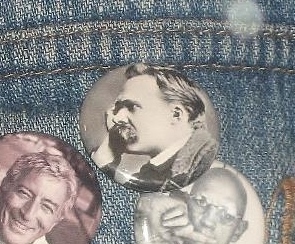 Anyway…he sent me a note asking “Where should I start with Nietzsche?”
The mustache. If I were to start with Nietzsche,
it would be that mustache.
What the bloody hell is that thing all about?
Agreed.
“But if we start there, we may never stop.
It was a legendary and epic ‘stache.”
I think he was asking what he should read first, guys.
For those of you newer to philosophy, Friederich Nietzsche was a 19th Century German Philosopher. He is best known for attacking many of the commonly held beliefs of Western and Christian culture, such as the notion of their being an absolute truth or absolute right and wrong.
I would recommend starting with Thus Spake Zarathustra, Andy.
Written throughout the summer of 1885, and first published i n 1886
as Also sprach Zarathustra: Ein Buch für Alle und Keinen
(although the 4th section was added in later printings),
it is written in a heavily poetic, rather mystical style.
It lays out its ideas using the central character Zarathustra
as the author’s spokesperson. It contains many of
Nietzsche’s central ideas, such as the death of God,
eternal recurrence, the critique of the superficiality of modern man,
the “Übermensch”, self-overcoming, and so forth.
Thank you, Peirce;
Brandon, would you throw him a fish?
Tako Nigiri, if you please.
All we have is canned tuna.
Any sesame wafers left?
We could top it with a dollop of that Kentucky Whisky Aioli,
crumble some of those Sriracha Potato Chips on it…
Cooking is about all Kentucky whisky is fit for…
As Peirce said, the book contains many of Nietzsche’s most important ideas, and they are well presented and dramatic. The most famous idea is the “Übermensch,” usually translated as superman or overman. This is a human who is constantly overcoming or overtaking or exceeding their own limitations, as well as the limitations imposed upon them by societal expectations, religion, and traditional morality. A lot of the fans of Nietzsche–his street cred–is based on this idea of the overhuman who rises above mundane morality.
When I taught college, I generally make students read the section on the madman, which discusses the death of God. One of the things I admire about Nietzsche is that he recognizes that the loss of God will actually have a tremendous cost to our culture. “God is dead! What will we do with the rotting corpse?”
This is maybe the most widespread misunderstandings about Nietzsche.
My dad took a Philosophy class in which the professor had written on the board
the first day the old joke,
“God is dead.” – Nietzsche
“Nietzsche is dead.” – God
In other words, “Suck it, Friedrich.” But it wasn’t Nietzsche’s intent to kill God. He just thought he was already dead, and insisted that we all make arrangements for the funeral.
The writing is poetic, even beautiful, and really fun to read. It is sort of like an ancient epic or holy scriptures.It is aphoristic, so you can read it chapter by chapter, and section by section, and don’t really need to study it.
Zarathustra is not, however, systematic or well argued.
Bloody Hell!
It has less logical structure than Wagner’s Ring Cycle.
Wagner’s Ring Cycle.
That would be an interesting Laundry setting;
I suppose it wouldn’t do for delicates, though.
For something with a bit more analysis, you might move on to the The Birth of Tragedy.
I agree.
Though it’s interesting that in order to move on we need to move back.
The Birth of Tragedy was Nietzsche’s first book, written all the way
back in 1872, when he was still a professor of classical philology in Basel
rather than a syphilis-ridden recluse in the Alps.
Which reminds me: Have you ever noticed how much “syphilis” looks like “Sisyphus”?
(Beware what you push up the mountain. It might roll back down.)
Syphilis or Sisyphus,
either way some poor bugger’s going to lose a rock.
I don’t get it.
You are better off not getting it, Peirce.
All righty, then.
The Birth of Tragedy, originally published as
Die Geburt der Tragödie aus dem Geiste der Musik,
or The Birth of Tragedy out of the Spirit of Music, it is an examination of Classical,
and, more significantly, pre-classical Hellenic culture.
Nietzsche explores the rise of the dramatic tragedies.
He contrasts the Dionysian ideal–one of ecstasy and freedom–to the Apollonian idea–one of control and reason. The original theatrical productions were tied to the ecstatic catharsis of the Dionysian rites,
but as it was fully developed, tragedy retains both elements in balance,
allowing the Greeks to look into the abyss of human suffering and affirm it,
passionately and joyously affirmed the meaning of their own existence.
While it has some commendible points, especially in the move away from the cold, rationalist , ordered thinking he calles “Appollonian,”
it is an oversimplificaton of Greek religious culture, ignoring the earthy nature of the other Gods–even Priapus or the phallic Herma.
Och! But before I spend the my hours criticizing Nietzsche
too much, I must say that it is a truer critique of that blasted bugger Kant then of Apollo.
You can critique Kant later, Wode,
maybe when he comes in for spring peas in dill later this year.
Yes, Nietzsche is definitely a spokesperson for the Romantics against
the dryness and over-rationalization of the Enlightenment.
Finally, Andy, I would recommend Beyond Good & Evil……
Ah. Beyond Good and Evil was first published in1886 as
Jenseits von Gut und Böse: Vorspiel einer Philosophie der Zukunft.
It is less poetic than Zarathustra, but still largely a collection of observations
and pronouncements in either paragraphs or even short sayings.
By performing a genealogy—an examination of the origins
and nature of Judeo-Christian morality—
he calls it into question, showing its reliance upon philosophical dogmatism,
and proposing instead a perspectivism. It is a dramatic call to arms
to those who cannot abide living within the controls of slave morality,
advancing an extra-moral wisdom to be shared by those kindred souls
who think ‘beyond good and evil’.
Salut, Vache interrompant.
It also introduces important ideas, like the will to power, and the idea that morality is an invention of the weak to handicap the strong.
OK, to wrap up, guys—is it weird that we are just guys? I mean, it doesn’t seem very inclusive. Except for Alex, the fantasy IT person, the Bistro only has males of the species….
“A woman is a woman,
and a man ain’t nothing but a male.
One good thing about him,
He knows how to jive and wail.”
Wait: Who is Alice?
Alex. She is our tech support. You haven’t met her, yet, but will at some point.
The service appointment window I was given was “the Twenty-Teens,
give or take two hours.”
Wrapping up, take two. OK, to wrap up, guys, I think ….
Haud yer wheesht, Skinny Malinky Longlegs!
You haven’t really captured why folks still read and quote Nietzsche 100 years after his death
and 130 years after he stopped writing. Although many of his romantic ideas had been expressed earlier, and even his nihilism had already been floating around for years—Dostoevsky had already critiqued the idea of the superman in Crime & Punishment in 1866, nobody writes the call
to arms against our certainties and complacencies better.
He is the John the Baptist of the absence of values, the John Knox of Post-Modernism.
He is the mustached prophet still preaching to punks, cyber-anarchists, and black clad emo kids.
Fair enough. When I was young and alternative and used safety pins as a fashion accessory, I carried a paperback of Zarathustra in the knee-pocket of my cargoes.
He is a wonderful thinker to work through, although you have to be careful not to make him an idol.
Wrapping up, take three. I think we should close by each quoting our favorite Nietzsche quote. Although I really like “but it is the same with man as with the tree. The more he seeks to rise into the height and light, the more vigorously do his roots struggle earthward, downward, into the dark, the deep – into evil.” I think I will go with:
Perhaps I know best why only humans laugh.
Only they suffer so deeply that they had to invent laughter.
This unhappy and melancholy animal is, as is proper, the cheeriest.
That faith makes blessed under certain circumstances, that blessedness does not make of a fixed idea a true idea, that faith moves no mountains but puts mountains where there are none: a quick walk through a madhouse enlightens one sufficiently about this.
 So many to choose from, but I will have to go with the chapter titles from Ecce Homo, which include “Why I am So Wise”, “Why I Write Such Good Books”, and my favorite: “Why I am a Destiny.” Whenever I do something breathtakingly dumb, I like to say, “This is why I am a destiny.” Oh stupidity, where is thy sting?
Without music, life would be a mistake.
![IMG_2040[1]](http://www.philosophybistro.com/wp-content/uploads/2013/05/IMG_20401.jpg) This is my Übermahl or Over-Meal, a process of self-transcendence that eschews traditional cooking and makes its home beyond the pale. It is also delicious.
This is my Übermahl or Over-Meal, a process of self-transcendence that eschews traditional cooking and makes its home beyond the pale. It is also delicious.
Ramps, for those of you who do not live in the Appalachian Mountains, are a variety of wild Leek than can be found in this region in the spring. It has a unique flavor, but is milder than onions or garlic..
![IMG_2036[1]](http://www.philosophybistro.com/wp-content/uploads/2013/05/IMG_20361.jpg) Step 3, People, people who knead pasta: When mixture becomes too thick to mix with a fork, begin kneading with your hands or your bread hook. Knead dough for 8 to 12 minutes, adding flour as it will take it—the final bit by hand even if you are using a machine. The dough will be harder than bread dough, and smooth and flexible.
Step 3, People, people who knead pasta: When mixture becomes too thick to mix with a fork, begin kneading with your hands or your bread hook. Knead dough for 8 to 12 minutes, adding flour as it will take it—the final bit by hand even if you are using a machine. The dough will be harder than bread dough, and smooth and flexible.Step 4, let it sit: Wrap dough tightly in plastic and allow it to rest at room temperature for 30 minutes.
Step 5, Roll on: Roll out the dough with a pasta machine or a rolling pin to your desired thickness. For the ravioli, I rolled it to about a millimeter. For long Pasta, I prefer it pretty thin. Cut into your favorite style of noodle or stuff with your favorite filling to make ravioli.
Step 5, alternate: Roll out the pasta into long sheets and place half of this 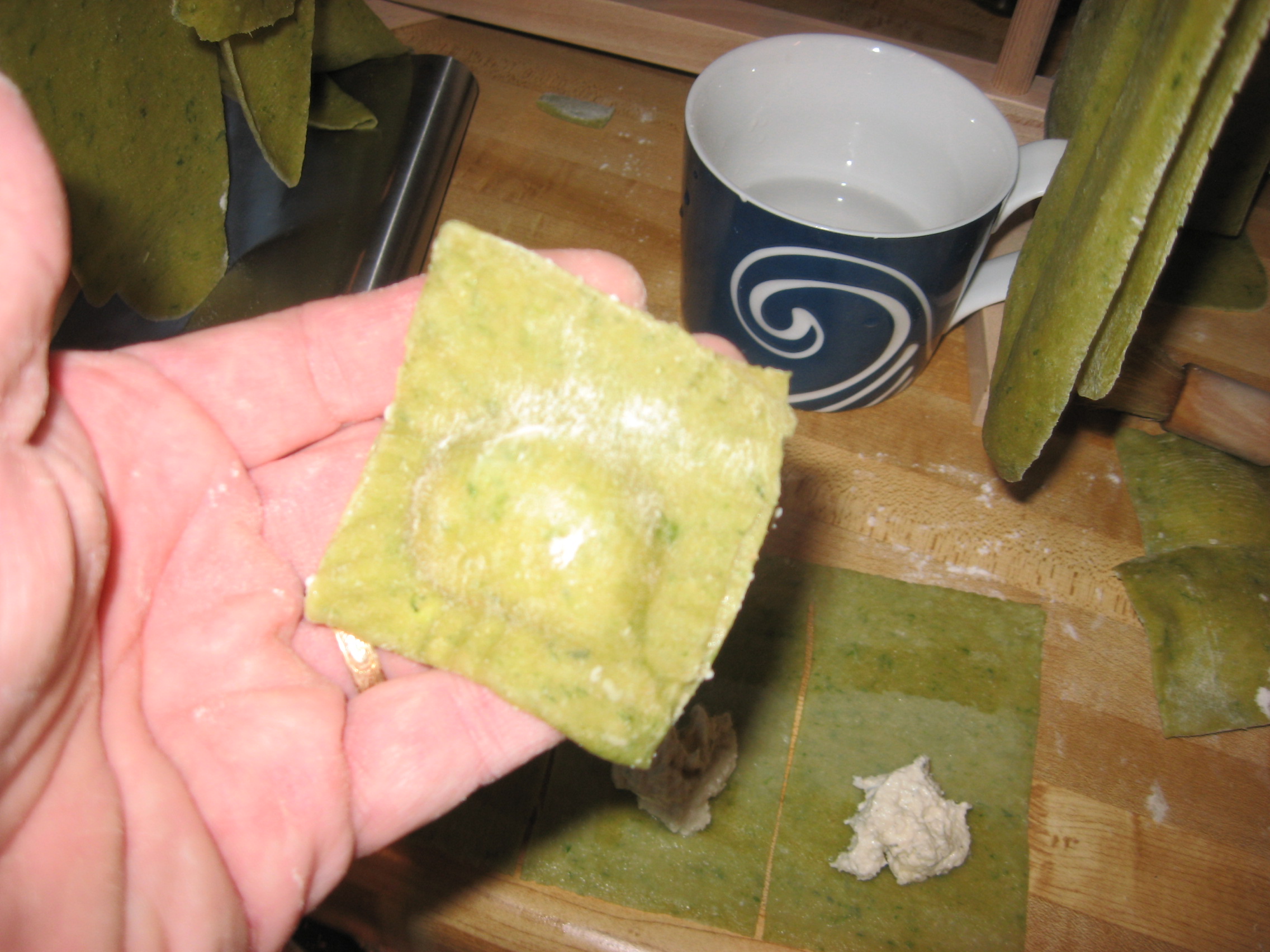 on a large, smooth surface. Put dollops of the ricotta mixture ad even intervals (do you like big raviolis or small ones?), and moisten the areas in between (to make the pasta stick). Cover the sheet with the other sheets and use gentle pressure to seal the little packets (or a ravioli roller, a cool but difficult tool). Cut in between the dollops—there is a crimper/cutter they make for this, but I use a knife. Press the edges of the packets with a fork to make sure they are sealed.
Step 6, cooking: Bring water to a boil in a large pot and add salt. Cook the pasta until al dente, 1 to 8 minutes depending on thickness. Drain, treat, and eat.
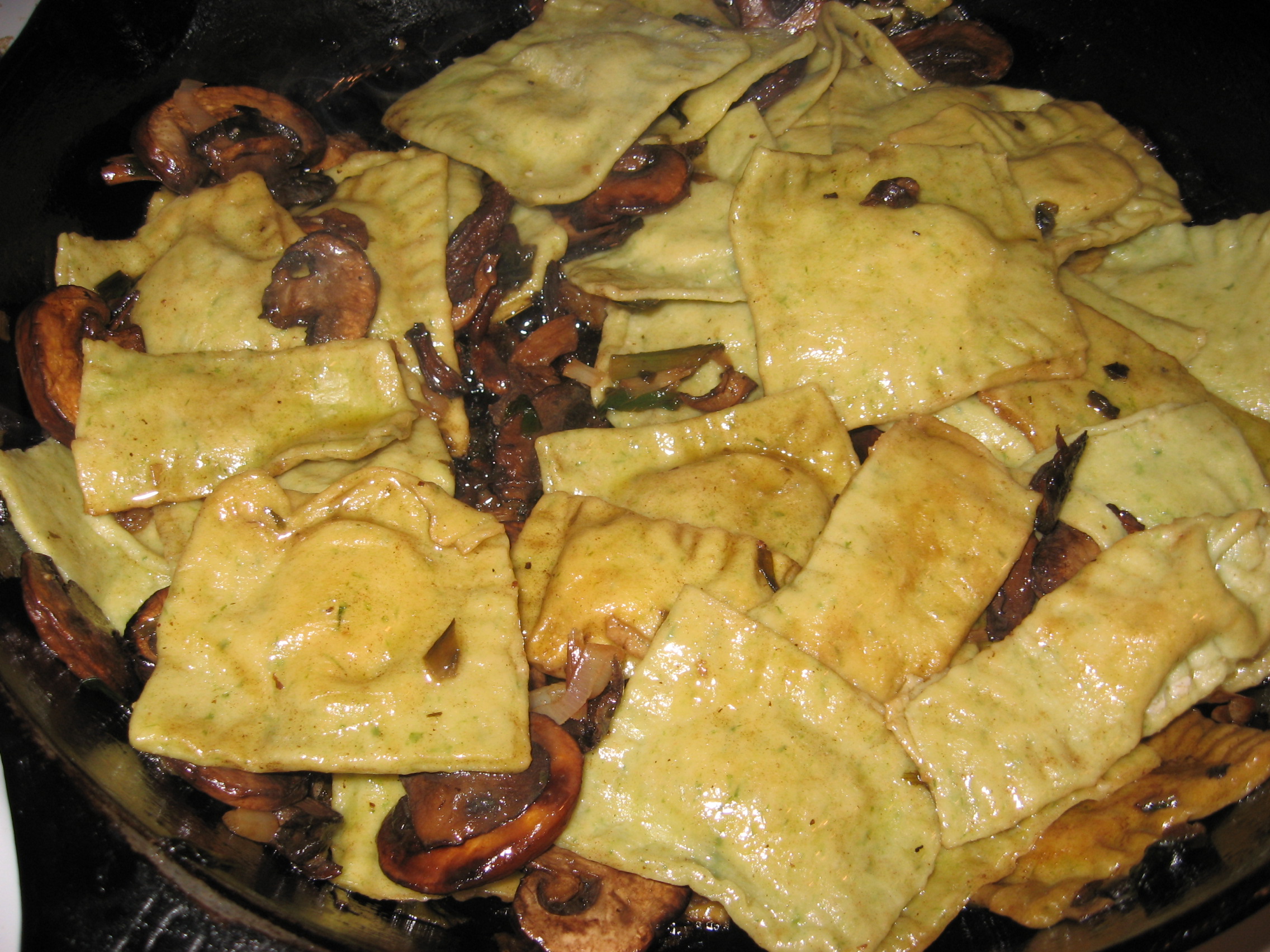 Extra Step, treating: You could just make some sauce, but for this, I prepared Browned Butter & Mushrooms. In a large skillet, sizzle a half stick of butter until it begins to brown. Add a half to a whole pound of sliced mushrroms, and allow them to brown as well. If too much of the liquide boils away, add more butter or a little white wine. Add some mixed garlic for the last little bit, long enough so it softens & releases its flavor, but not long enough to brown. Dump the pasta into this.
We all have weird little things that annoy us.
I realize that we language freaks live in a different world than most people. I try not to wince when people use whom and who incorrectly, and I try not to slap folks who use impact as a verb.
I realize that we foodies live in a different world than the most people. Your loss.
I realize that we philosophers live in a different world than the most people. I try not to wince when people confuse strong arguments with valid arguments, and simply giggle to myself when folks describe things as being phenomenal. However, we all have issues we feel must be addressed, and the time has come (the walrus said) to talk of one such thing.
Looking at some children’s books the other day, I was shocked. Isn’t it about time we told children the truth instead of filling their impressionable young minds with half-truths and fable? Science isn’t scary; ignorance is what is scary.
I saw some brand new picture books about the five senses.
NONSENSE!
Let me make one thing perfectly clear: there are more than five senses. With only five senses, you couldn’t even get out of bed in the morning. For one thing, without equilibrioception, the senses which give you feedback on your equilibrium, you couldn’t get up at all. Without the sense of proprioception, the sense of bodily location, you wouldn’t even know if you were up.
Scientists disagree on how many senses we actually have, but depending on how you  parse them, we have anywhere between 13 and four dozen. What I mean by parsing is this: we would all agree that we have a sense we call sight. Is color perception the same sense as light perception, or are these two (within the eye, there are two distinct structures which provide each) separate senses? Is depth perception, which couples visual input with an awareness of the angle of the eyes in relationship to each other a separate sense?
Similarly, are the five different types of mouth taste—sweet, salty, sour, bitter, and umami—all one sense, or are these five senses?
We know very little about smell, in large part because it is so complex. Odd that taste, which is relatively simple, is broken down into 5 different sensations, but smell, which is tremendously complex, is left as just one sense. I believe my dog, who can sniff a storm on the wind, would beg to differ.
 Hearing is also mysterious, and from a phenomenological perspective fascinating, since it includes speed and frequency and duration—it is the closest we come to sensing time directly.
For folks who persist in the notion that there are only 5 senses, everything else is touch. Yet even for the common view of touch, is using my fingers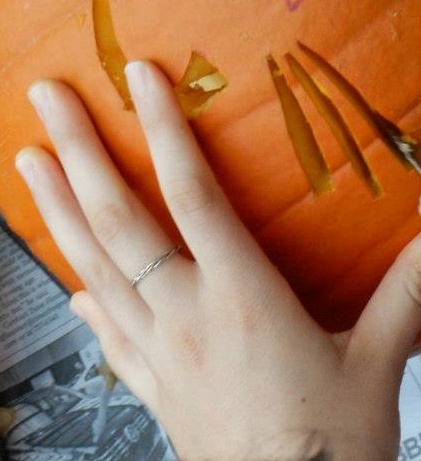 to sense the roughness of jagged granite, the pressure of a hand squeeze, and the temperature of the water in the dishrag bucket them same sense? If I were to feed you a grape, when you feel the pressure and give of it against your teeth as you bite into it, or when you feel the warmth of my breath against your cheek, or the gentle brush of my fingers across the back of your knee, are these all the same sense or are they different senses?
These, though, are only the outwardly directed senses. We in Western cultures are terribly forgetful of the body (you might not be at the moment, since I just tickled the back of your knee, but we as a culture are—trust me. And don’t get me started about Platonism). Most of the nerves we have are involved in provided us with feedback about our own bodies—even though these sensations often do not register consciously. When you kick me under the table (probably because I touched your knee), you will not have to look to see where your leg is—proprioception will let you sense where it is. This is useful if you drop something (your napkin, the Romanov jewels we lifted earlier that evening), have to locate it by feeling around with your foot, and then reach down—knowing where it is because you just felt it and knew where your foot was—you reach down your hand and pick it up.
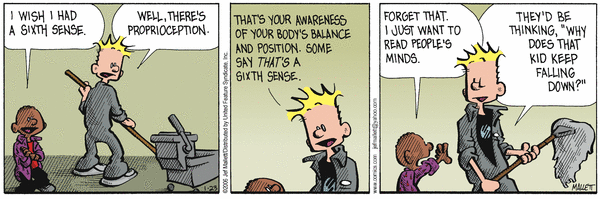
If you don’t read Frazz, you should; It’s one of the best cartoons out there.
In particular these kinesthetic senses are important because they allow the body to be the base from which all other senses operate. The kinesthetic sense of eye movement and adjustment is an important part of visual perception. Knowing where are body is allows the sense of touch to be effective. Body awareness allows us to integrate the external senses into a coherent awareness of our world. I have a good friend (Hey, Mel) who spends a great deal of time each day, each week retraining children who have an inadequate kinesthetic sense—an inability to be aware of where there body is. These senses can go haywire, and when they do, it affects everything.
How about temperature? You can sense the temperature of the air around you, but you can also sense your internal temperature. There is a tremendous difference in the different ways of sensing pain—pain on your skin (Cutaneous nociception), pain in your bones or joints (Somatic nociception), or internal organ pain (Visceral nociception). Nausea is sensed, but doesn’t fall neatly into any of the traditional 5 external senses, but also seems different from the pain of a stomach ache or a gut punch. Hunger is similarly sensed, but is a radically different feeling, and can be sensed either as a feeling of the stomach, or as a feeling of needing to eat, which is more realted to how the body feels in general. So many of these senses are vital to our survival, yet we don’t think of them as at all worthy of attention.
So enjoy your senses. Focus upon one at a time. Play with how many of them are involved in enjoying your meal tonight at the Bistro. They are all sensual–proprioception seems rather dull, but the sensation of dancing is magnificent. Equilibrioception is mundane, but we love playing games with it on swings and rollercoasters. Your senses are a wonder, but even this mystery pales beside the great mystery of how the mind puts them all together, and the greatest mystery of you being you.
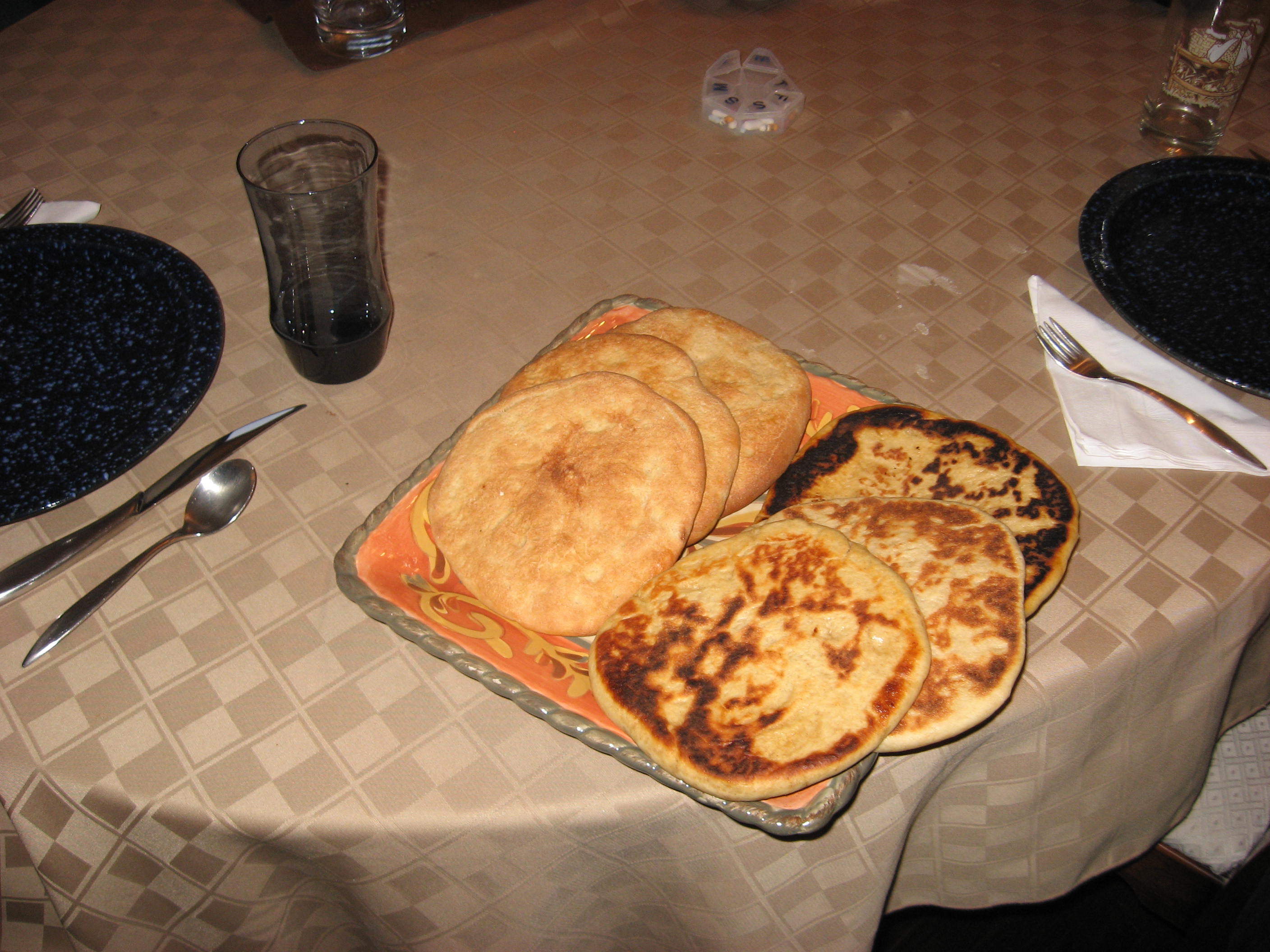 This recipe is adapted from a pita bread recipe my friend John—an excellent baker—got from Cooking Light. There are certain tricks—either oven or stove top, spritzing the breads with water to make them puff into pockets—which you can experiment with.
Ingredients:
Step 1, I demand proof!: In a large mixing bowl (or the bowl for your mixer), whisk the honey and the yeast in 1 cup of warm water; let it stand 5 minutes to make sure it bubbles.
Step 2, yeast at work: Add in the wheat flour and let the mixture rest and rise for 10 minutes.
Step 3, mix & knead: Add in the yoghurt, olive oil, and salt. Gradually add in the remaining bread flour, switching to kneading or the bread hook as it becomes stiff.
Step 4, walk away again: Coat it with olive oil, put it in a big bread bowl, cover it, and leave it alone to rise until it is doubled, probably about an hour.
Step 5, short division: Divide the dough into 8 portions. Roll each portion into a 6 inch or so circle.
Step 6, choosing: At this point, you have two choices: baking the flat breads, or cooking them on the stovetop. My preference is to do four of each; the griddle ones are better fresh, the oven ones are better the next day, and it takes too long to do either alone.
Step 7a, baking: Preheat the oven to 500°, and position the oven rack on the lowest shelf. Grease a baking sheet heavily either by hand or with spray. Bake the rounds, one sheet at a time, for about 8 minutes or until puffed and browned.
Step 7b, griddling: Heat a large griddle, like an iron pan; grease it lightly.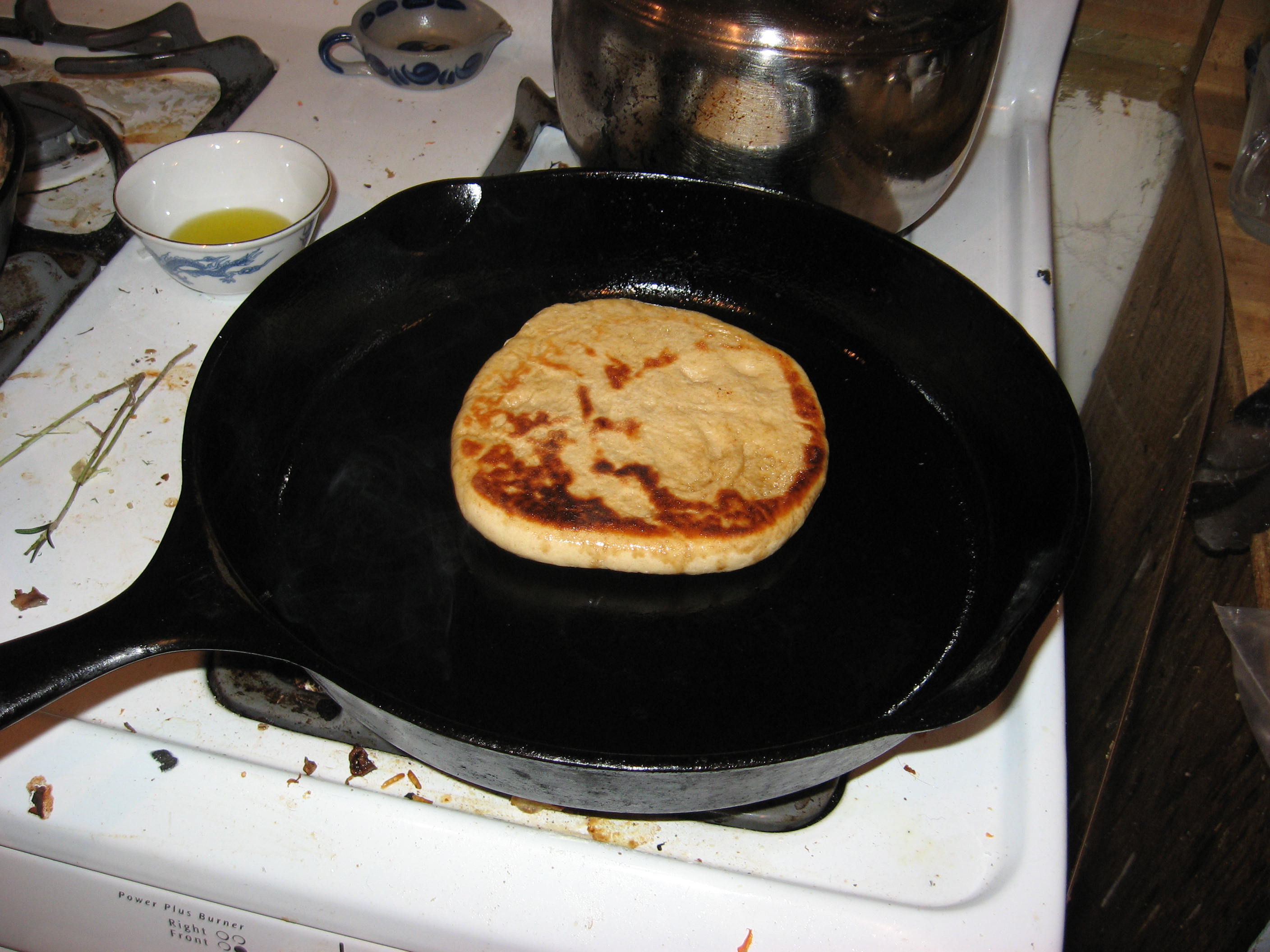 Place each round on the pan, flip after a few minutes before it begins to scorch. If you sprinkle a little water on the rounds, they will be more poufy, if you prefer them as flat bread, roll them thinner.
Step 8, wrapping up: Cool on a wire rack.  Serve as part of a Mediterranean meal, or with the White-Bean Dip, or with Hummus, or for sandwiches. Just do your best not to eat alone.
 A note from Brandon: The title makes it sound like this post is about Saturday Night Live’s Continental. Don’t be fooled.

If my 18 year old self knew I was writing a non-ironic post on this topic, he would smack me in the back of the head. Hard.
Some friends were reading Gary Chapman’s The Five Love Languages and suggested it to K and me, so we gave one of the book’s quizzes a try. It asks people to compare how important five different means of expressing respect and affection are to them: gifts, attention, affirmation, help, and touch. We didn’t learn anything too surprising, (K [No, not that one] already knew, for instance, that I rarely care about gifts, even though I appreciate someone carrying enough to pick one out for me), but the exercise led to a nice discussion about what makes both of us feel loved. If you can get your family to put their smartphones down for a minute, it could provide a good way for you all to reconnect. (Oh, who am I kidding? Surely there’s an app by now. Tell them they can pick their phones back up.)

A student once asked me after class if I thought Patterson Office Tower – P.O.T. – had secretly been named in honor of Kentucky’s de facto leading crop. Examining his bloodshot eyes more closely, I asked how much pot he had had to smoke to come up with the idea. He grinned nervously then ran away. I miss Kentucky sometimes.
One day in graduate school I was wandering the 14th floor of Patterson Office Tower trying to decide what to write my dissertation on, when the head of the department stopped me to note that one of the best things about our field was that you could study anything and call it “Philosophy.” Specifically, he noted that “You could even write about surfing and call it the Philosophy of surfing.” As he walked away I asked myself, “Does Don really want me to write about surfing? Or is this his subtle way of telling me that I’m being very undude (NSFW)?” But it was neither. He just wanted to point out that you can philosophize about anything. Even love languages. So here goes.
First, let’s talk about what makes a language. Language has two main components: meaning and structure. Many linguists, following Noam Chomsky‘s lead, have paid greater attention to the latter, cataloging the rules for combining words into phrases and sentences that native speakers normally pick up without realizing they’re learning them, often without being able to explain them. (It was fun to sit around the Stammtisch and realize that we non-natives had an easier time spelling out the rules for which form of “the” to use in German – der, die, das, den, dem, des – even though our Germans friends could of course follow those rules more fluidly than we could. As compensation, one of those Germans had a name for a verb tense we liked to employ in Kentucky in sentences such as, “If he’d wanted to get home before midnight, he would have had to have driven his own car” – which we naturally made trickier to track by pronouncing the key phrase, “woulda haddawa.” Its official name was something like the “past pluperfect hyperbolic subjunctive,” though I still prefer to think of it as “the woulda haddawa tense.”) But although structure is essential to language as we know it, it’s still secondary to meaning. Structure is like the steel frame supporting a skyscraper. Meaning is everything that fills in that frame – even if its only a single story – to create a room where people can work and live.
The easiest way to understand what meaning is is to relate it to action. When I dig holes in the dirt, plant seeds, and water them, my actions are directed at getting plants to grow in my garden. My behavior is making a physical difference in the world. But as all social animals know, every action can also communicate. If for instance, my spouse and I have been squabbling all weekend about whether we’re each doing enough around the house, I might engage in all that gardening activity in order to demonstrate that I’m doing my part. In addition to their physical effect, then, my digging, planting, and watering also convey the meaning that I contribute to the household. All actions can have meanings. Language is distinct in minimizing physical effects in favor of maximizing the meaning it conveys. Speaking always has physical effects on the environment, including increasing the carbon dioxide in the room. But such physical effects are nearly always less significant than the meanings of our words. (That’s why when our words are particularly meaningless, others say we’re full of “hot air.” The quality of the gasses that extrude from your mouth should be the least noteworthy aspect of your speech.)
By this measure, Chapman’s categories hold up well as examples of language. Giving someone a gift or a hug doesn’t have the grammatical structure of a sentence like, “Ah, my great bundle of sweetness, it is love, love, love at sight first,” but they likely do a better job of expressing your care for the recipient. And even if these exchanges have greater physical effects than speech usually would, in most cases I would expect the meaning they convey to be more important. So I’m going to side with the author here: the examples he offers really should be considered languages of love.
But that’s not what I wanted to talk about. What really grabbed my attention was whether Chapman had captured all of the major categories of love languages. Check out that list again: gifts, attention, affirmation, help, and touch. Are those the main ways you give and receive love? A little Googling shows that at least one commenter has suggested food as an additional category, which fits nicely with the theme of the Bistro. The other option that comes to mind for me is play.
Play is so essential to my way of being in the world that I can hardly imagine life without it. I’m approaching the end of my first year living here in the Pacific Northwest, and while there is so, so much I love about this place, I’m still building my network of friends. That’s in no way a knock on the wonderful people I’ve gotten to know, who are kind, helpful, neighborly sorts all around. But very few of them want to play as much as I do. I realized this in part because I got to have coffee a couple of months ago with someone who does like to play that much. Without intending to, we immediately fell into the sort of goofy verbal sparring that I’m almost constantly engaging in by myself when I don’t have anything better to do (and often when I do). Our whole conversation was just the perfect balance of serious discussion punctuated at nearly every comma and full stop by some absurdity. I could analyze why play like this means so much to me – how it alchemically transforms both everyday and existential frustrations into sudden and enduring bursts of joy – but I don’t even think that’s the point. The point is simply that play does make me feel alive and connected in a way nothing else ever has or will. It’s my principal language of love.
So that’s the question I’ll leave you with as your after dinner mint: What’s your language of love? Don’t feel generic if Chapman captured yours. This isn’t a contest.  But whether your favorite is on his list or not, I’ll suggest that it’s a valuable and affirming thing to know about yourself.
So: What’s your real native tongue?
Photo credits: Gary Chapman, University of Kentucky
Community & Individuals, part 2
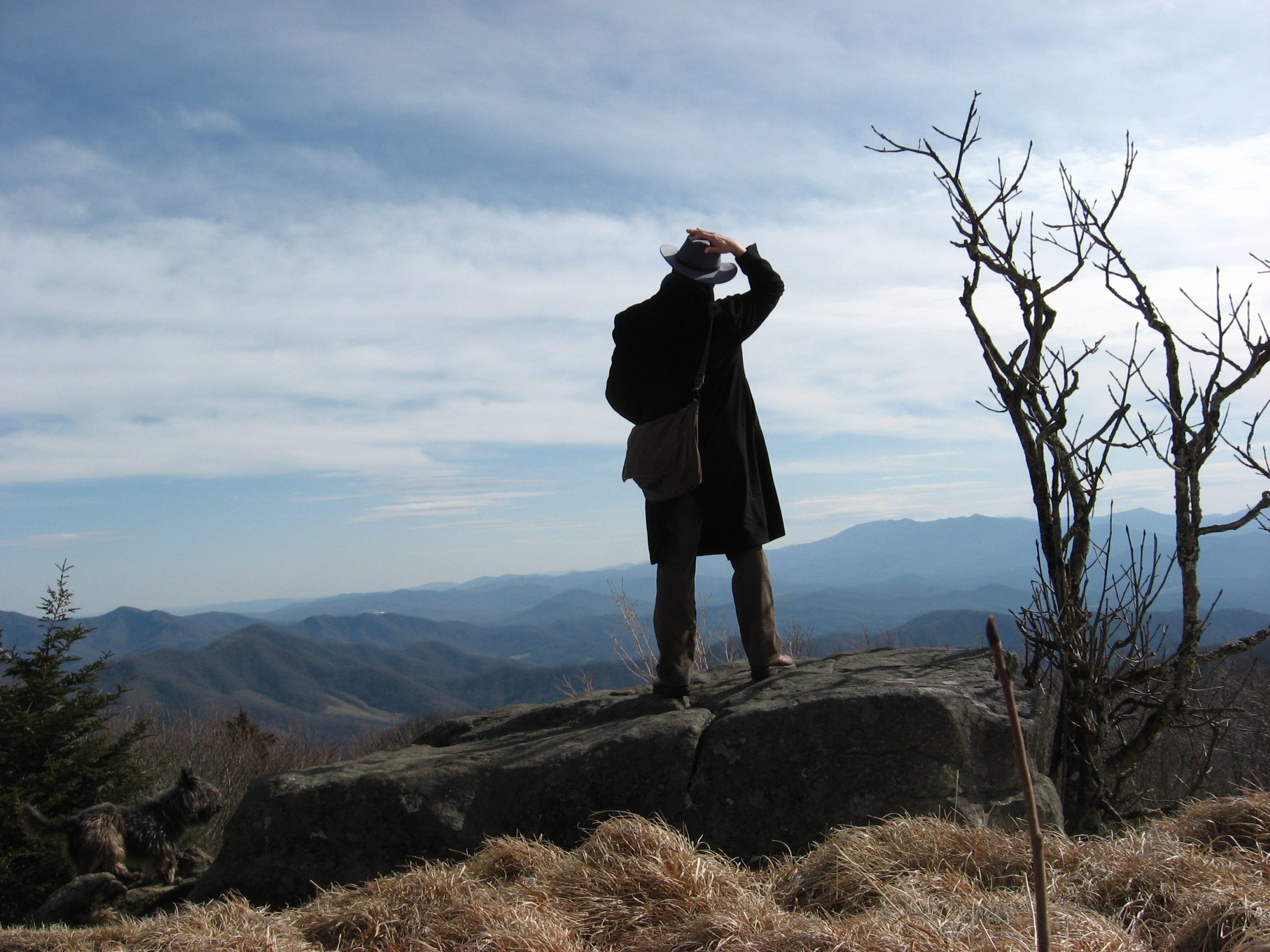 In discussions of human nature, one of the central questions that soon appears is how much of who we are is determined by our biology, our genetic code, how our brains, nerves, & bodies are wired, and how much of it is shaped by our culture, the deliberate and accidental conditioning of our upbringing, the communities to which we belong?
To borrow a phrase I heard our mutual friend Mike use, “It’s a ‘both/and’ sort of thing, not an ‘either/or’ sort of thing.”
Although my area of research is much more focused upon the cultural community social side, I cannot deny that it is closely tied to, even dependent upon, a hard-wiring that makes us capable of being adapted by our environment. Our genetic heritage also seems to make us pre-programmed to live together with others. By nature, we have a long developmental period, which leaves us dependent upon others. Most of the evidence suggests that we have an inborn drive towards interaction with others; we are pulled to nurture and to be nurtured. We are naturally drawn to others like us, and pulled towards living in community. With the exception of some unusual conditions causing sociopathy or developmental delays or other issues, we are capable of empathy and language.
Although we have capabilities for interacting with our world, most of the tools we humans have to make sense of it are derived from our community. Even those that aren’t—those fundamental categories such as time, space, motion, color, cause & effect—these are all skewed and adjusted to fit the tools our community gives us, as well as to meet the need our community presents us with.
Since thinkers first started looking at human nature through the theoretical tool of evolution, the relationship between the individual and their community has proved difficult to deal with. While clearly humans survive as individuals to pass on their DNA to the next generation, is our survival as a species more due to our persistence in groups, much like the survival of other social animals like ants, bees, and termites?
We are, as Aristotle said, sociable creatures, and we are drawn to the society of others. That is our genetics, our conditioning, and our habit. However, as Kant pointed out, we are troubled by a human nature marked by “an unsociable sociability;” we want to be with others, but we also want to be alone. As a species, we seem to be designed with an inner dichotomy of occasionally conflicting ends: we are individuals with individual needs, pleasures and desires, and, as a species, we are also communal, needing to be part of a community’s needs.
It’s not even really a “both/and thing;” it is a both/and & more thing.
Persons and groups are constantly engaged, constantly influencing and changing each other. Individuals and communities are in constant conversation, sometimes in a open dialogue allowing both to flourish, sometimes one of control and resistance, mostly somewhere in between. However, just as a community is always more than just a conglomeration of its parts, an individual is always more than just a member of a community.
Since the 80s—ironically, as a pathological individualist in one of the most individualistic decades imaginable—I have been a researcher of, a theorist of, an advocate for, and a member of communities. It seems to me after the isolation, individualism, selfishness, lost-ness and fragmentation of the last few decades, I see many more people moving towards living in community—either accidental communities or intentional communities.
However, as my last post indicated, my 25 years of experimentation have left me uncertain of community as an end in itself. Theoretically, human needs are rather similar and consistent, and forming communities within which these needs are satisfied,
allowing, as my friend Jeffery Nicholas puts it “human flourishing.” However, in practice, humans in groups large or small seem much more complex, and we might consider more flexible social groupings.
It seems to me, instead of being deeply bound to community, instead we have moved towards an individualistic serial sociality, where we connect ourselves to the orbit of a community for extended periods of time, form bonds and relationships, work together towards common goals, but then can shift or even move on. We are not monadic, but we remain nomadic. I think that 25 years ago, I would have critiqued this trend as just another form of individualism—which it is—or as boutique communitarianism or niche tribalism—which it can easily become. I think, however, that serial sociality does satisfy our basic human needs to be part of a group without compromising our own individuality. It also prevents the insularity of belonging to a group and the tendencies to start dealing with other humans through the dualist lens of us and them.
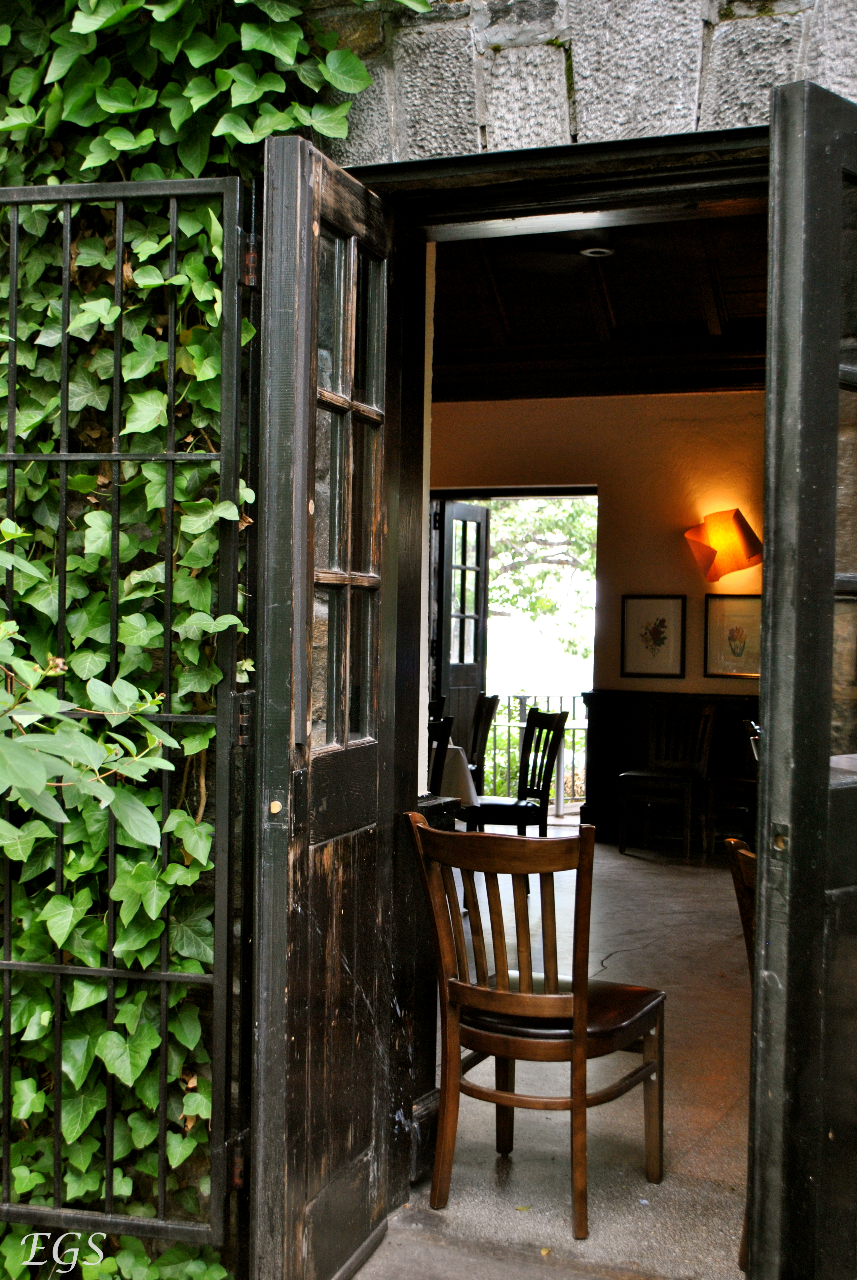 Healthy socialities form just as easily at workplaces, coffee shops, bars and on the trail as they do in colleges, churches, families, and intentional communities. One might argue that they are not as nurturing or as stable as groups that have a stronger commitment to each other, but I’m not sure that is the case; a bar is as likely to take up an offering for a member in the hospital as a church is.
I have no doubt we need each other; the question is: how?
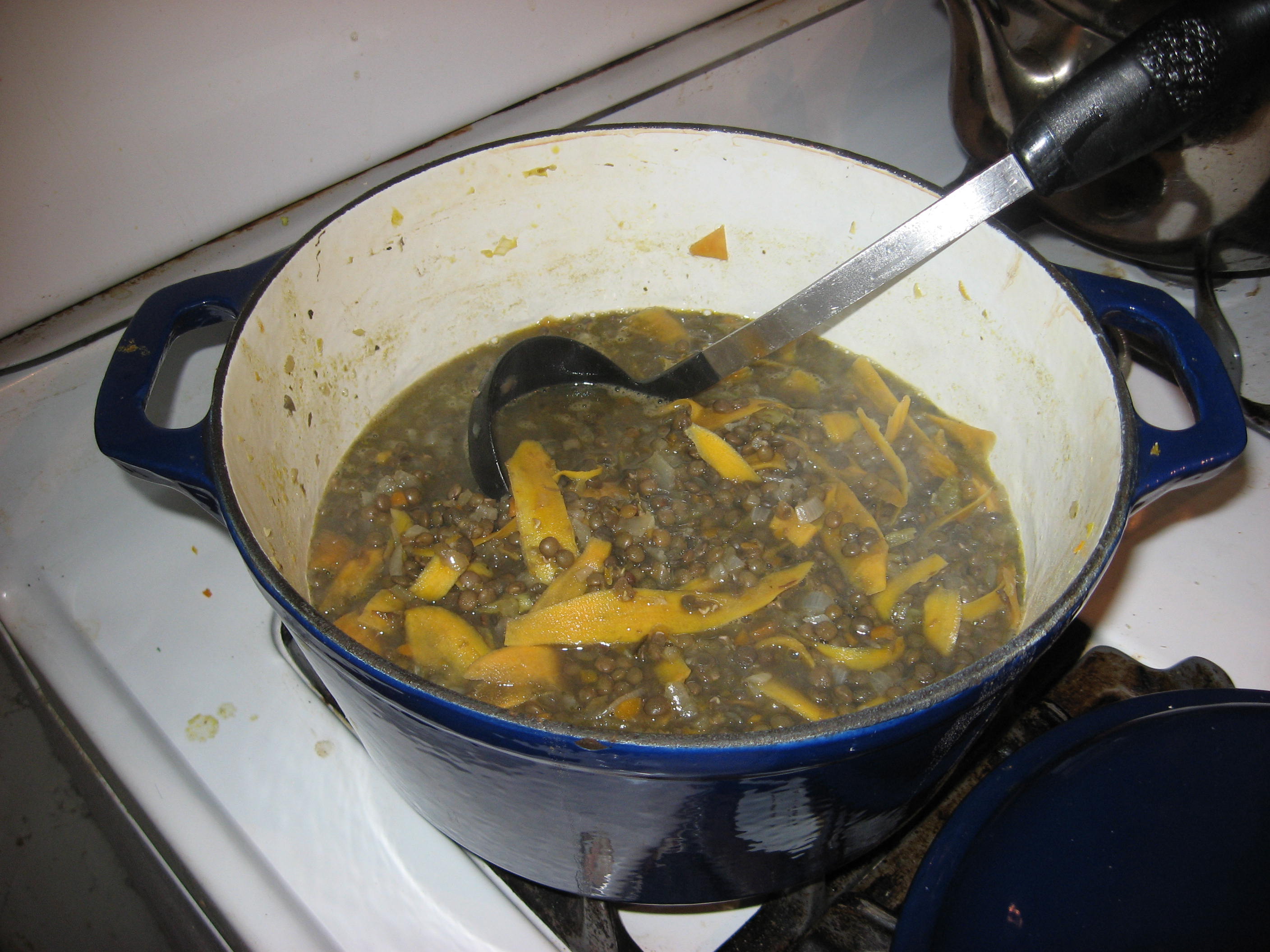
I realized that I had not done a proper entree for a while.
I am also coming to realize that the bit of philosophy at the end of my recipes might be the best I produce all week.
Ingredients:
Step1, Low Boil: Put the lentils, stock and bay leaves in a large pot. First, bring it to a boil, then reduce the heat to a low simmer and cover the pot. Let this simmer for an hour or more, like bitter resentment.
Step 2, Low Sauté: We are making a Mirepoix here 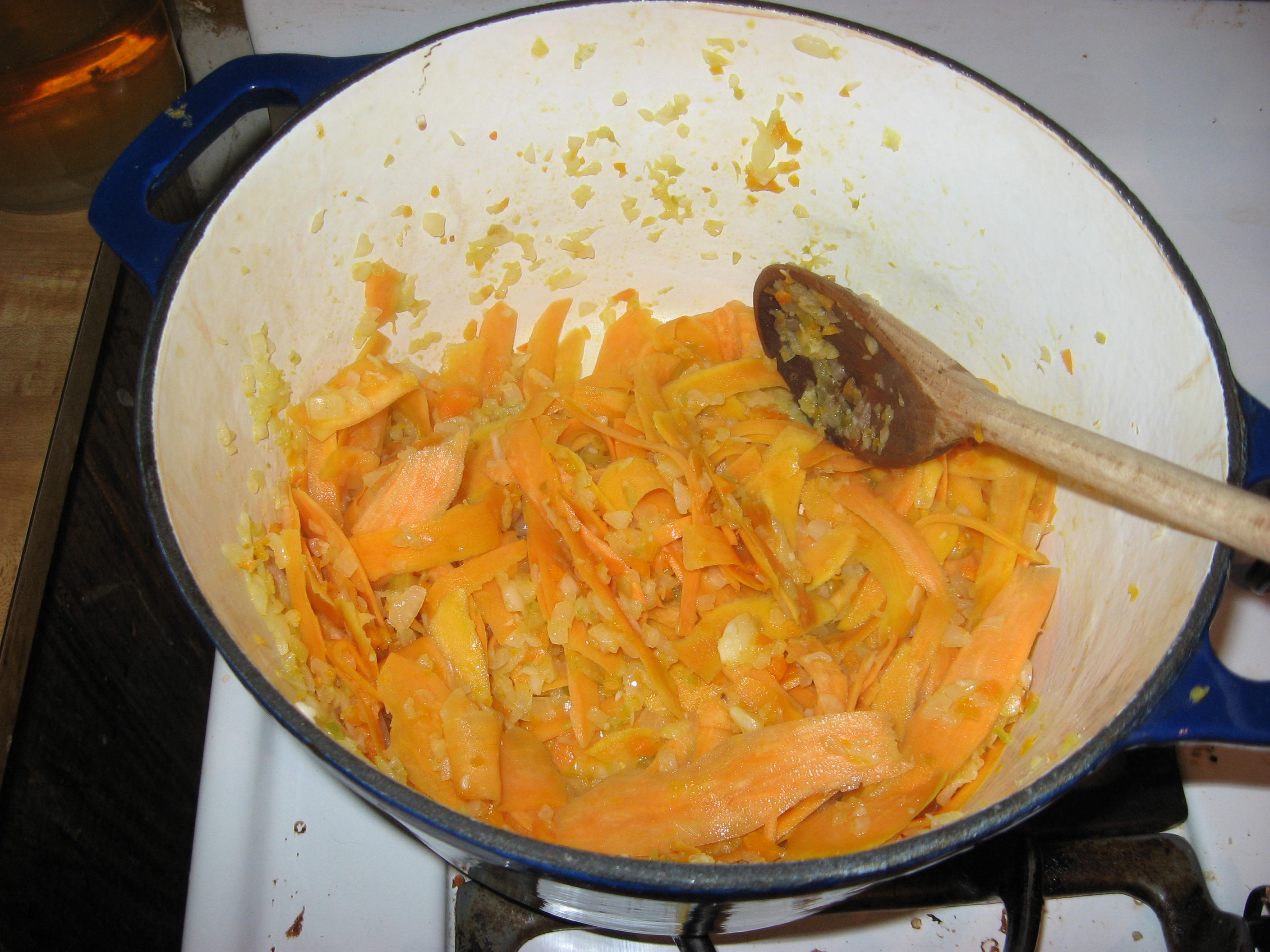 (I like mirepoix; mirepoix are cool). Heat the olive oil in a large, heavy soup pot (or pan if you don’t own two pots) over medium heat. Add onion, carrots, and celery. Stir the mixture until it begins to cook, then turn it to low and let it slowly cook for an hour or so. About 20 minutes before the lentils are ready (or you are), add the sweet potato; about 10 minutes before they are ready, add the garlic.
Step 3, mix it up: Add the lentils to the mirepoix (unless you used a pan, then add the mirepoix to the lentils). This is a good time to fish out the bay leaves.
Step 4, fiddle a little: Add the herbs and more salt to taste, if desired, and cook 15-30 minutes more. Add more things or other things until it seems right.
Step 5, share it with other people around your table: Add some freshly baked bread, maybe some salads, some good cheese, and share it. As always, there may be leftovers for monks, students, et.al.
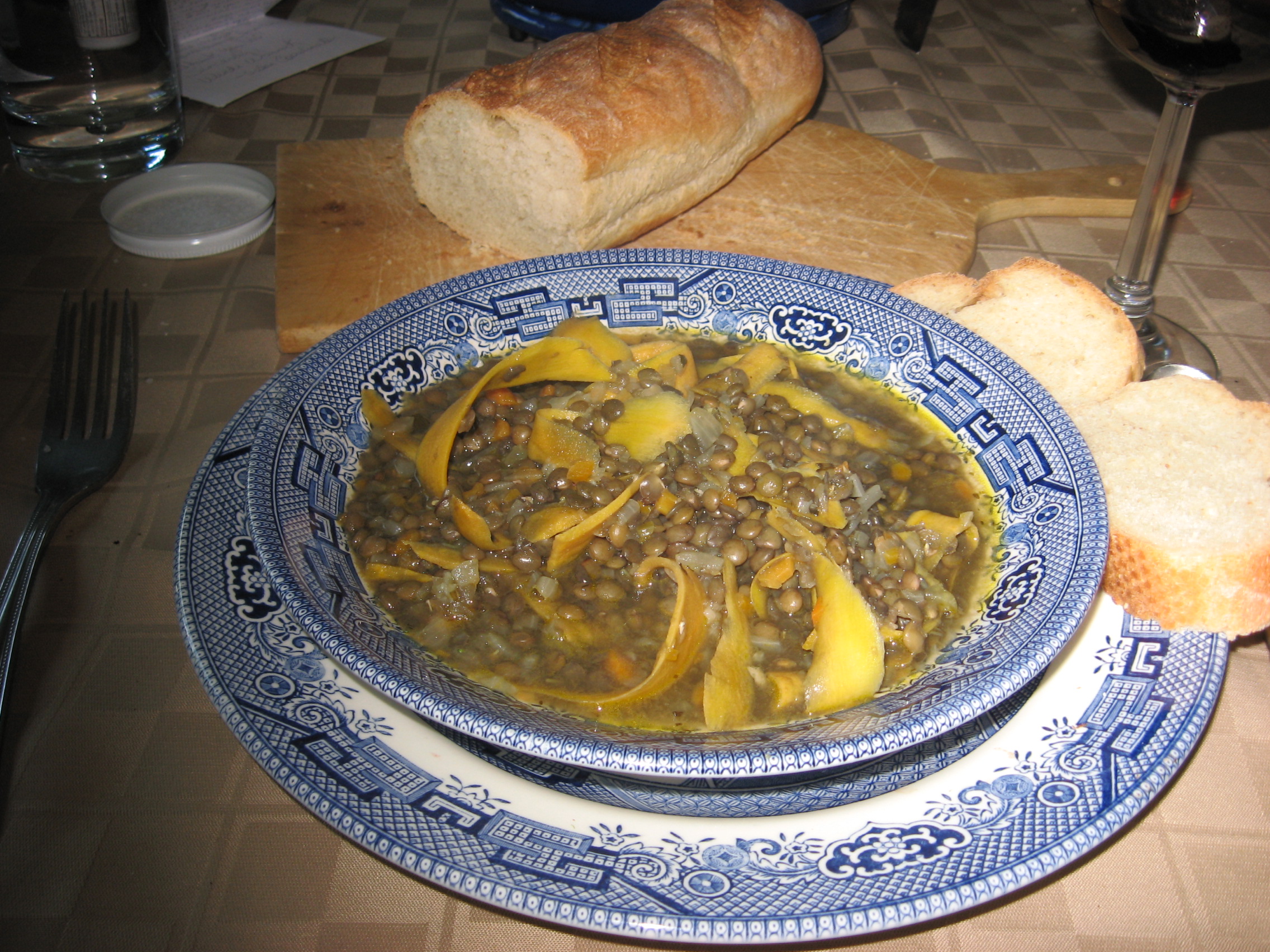 Is this the basis of community? No, not really. It’s not a bad place to start, but this is hospitality. Friendship is when others bring cheese (or wine). Community would involve helping with the fine mincing, or washing & drying the dishes together.