Sympathy for the Sophists

If you asked most Philosophers where Western Philosophy began, they would probably say “Ancient Athens” and leave it at that. But if you kept buzzing at them, gadfly-like, they would likely cite Socrates’s challenge to the Sophists for the hearts and minds of Athens’ youth (read: male, propertied elite) on the question of whether they should learn the Sophists’ art of winning arguments regardless of whether or not one is in the right, or instead Socratic pursuit of truth for its own sake. This is the mythic origin of the Philosopher’s creed that truth is more important than influence and other worldly goods. The unexamined life, as the say goes, is not worth living. And that  examination must be rigorous even if the rigor leads you toward denial of the world and your self. It’s a heady principle, with more than a little resonance with Christian asceticism. Socrates, too, was a martyr after all.

“Two words, fellows; two words: hemlock smoothies!”

I though about all this recently while pondering an open letter from San Jose State University’s Philosophy Department to Harvard Philosophy Professor Michael Sandel. (You can see the letter here and Dr. Sandel’s response here.) At issue is the attempt by the San Jose State to offer Sandel’s famous course on justice as a MOOC – a massive open online course. (If you don’t know what a MOOC is, you might consider it the educational equivalent of World of Warcraft. And if you don’t know what World of Warcraft is, I’m not going to corrupt your pristine worldview further here.)

This is actually a Moog synthesizer, not a MOOC. Isn’t it pretty?

The background for this case is the ongoing effort by colleges and universities to use technology to control instructional costs – an effort that has largely failed to date – and the corresponding response by faculties across the country to prevent what they see as the mechanization and de-professionalization of teaching. This letter fits neatly into the debate as it has developed to date, but is nevertheless noteworthy for being so public and for making a justice-based appeal to one of the world’s most prominent theorist of justice. That, I suspect, is why it made the Chronicle of Higher Education.

But that’s not why the letter interests me most. Instead, I’ve found myself thinking about how well it measures up to the standards of Socrates vs. those of the Sophists. Now, in Philosophical circles I’m using loaded terms here, and maybe even fighting words. The adjective “sophisticated” notwithstanding, no Philosopher wants to be compared to the Sophists. But I mean the comparison in good faith. It’s my view that the San Jose State Philosophy Department’s public protest holds up better if evaluated as a piece of political rhetoric, evaluated primarily on its persuasiveness, than if it is judged as an attempt at pursuing the truth in Socratic fashion. And I wonder if we should expect otherwise, even from Philosophers.

The letter’s argument is not by any means bad, but it does not meet the standards that I’m sure most of its authors would set for works in their field. Specifically, the authors: (1) direct their letter to Michael Sandel, but their disagreement is more properly with their university’s administration (and with similar-minded stakeholders in higher education generally), (2) don’t spend any significant time dealing with the values and interests motivating their opponents to offer this massive online class, and (3) pile their arguments on top of one another in a jumble instead of pulling each issue out for distinct consideration. Philosophically, each of these steps is a misstep, and collectively they threaten to turn the whole enterprise away from reasoning and toward rhetoric. The letter is otherwise well written. If a student majoring in another subject wrote such a piece in an upper level Philosophy class, her professor would likely praise it while noting at the end, “If you were a Philosophy major I would expect a little more from you at points.” A revised version directed toward the San Jose State administration, that dealt thoughtfully and charitably with the administration’s own words and positions, and treated each distinct issue independently would better exemplify Philosophy in practice. It might also lead the letter’s audience and authors alike to a greater understanding of this fraught moment in higher education, and even indicate some ways forward that would make effective use of new instructional technologies while preserving the aspects of the current system most professors would like to retain.

That may be setting the bar too high, but I do think that a more Philosophically rich letter than the one the San Jose Philosophy Department wrote could conceivably have such effects, bringing us at least a glimpse of the deeper truths of this situation rather than, in effect, just saying, “No!” to a perceived threat. Yet in that alternate universe, would anyone read such a letter? And would it persuade anyone who read it?  Those seem to me the relevant questions because the letter that appeared in our own universe is not only “sophisticated” in the three ways I listed, it is also highly effectively  so. By publicly targeting Michael Sandel, dismissing the motivations behind offering this MOOC, and layering their arguments one upon another in an emotionally resonant way, the department created a powerful piece of public persuasion. People are talking about it – at least as much as anyone ever talks about Philosophy departments. The bullet to bite here is this: let’s assume that this trade is necessary, and persuasiveness in this case comes at the cost of Philosophical rigor. Is the trade worth it? And how should we answer that question?

Cut to the house of a friend of a friend down in Portland, Oregon where I attended a barbecue last weekend.

Portlandia isn’t really making anything up.

At one point one of the attendees, a union organizer, told a story about being at a hotel in Washington D.C., realizing that the next hallway was full of demonstrators with, let us say, somewhat different political views from her own, along with their unattended homemade placards and signs, and being sorely tempted to engage in a little sabotage. When her six year old daughter started asking questions about this, she clarified that it’s never right to take someone else’s things without permission – “unless it’s politics,” in which case sabotage can be OK. My first thought was Philosophically smug: as a good Socrates-inflected liberal, I believe in free speech, particularly of the sort I disagree with – since, after all, that’s the only time that belief is tested (Why would I want to suppress speech I agree with?). Then I had my second thought: is that the right attitude for politics? This union organizer runs campaigns. She’s helped people. I still can’t agree with her on this issue of sabotage, but I also sympathize with the people she supports, who want decent wages and some job protections in an iffy economy, and who when faced with the choice between a little more wisdom or a little higher pay probably don’t hesitate long deciding.Go too far down this road toward political expediency and you can justify anything, which surely can’t be right. But do we really need to go all the way in the other direction, putting truth and reasoning and all that jazz ahead of persuasion and effectiveness?

I’ll answer this way: Philosophically the San Jose State Philosophy Department’s letter earns a C. I expect more from Philosophers. But politically it gets an A. I still long for the kind of analysis this group probably could write, that would honor their interests and values while also giving equal attention to the motivations of their opponents, some of whom sincerely want to provide students with good educations – and in the humanities no less – without leaving them with crippling loans. But I also know enough about how higher education makes decisions to know that no one’s waiting around for such analysis to help them make up their minds. I can long for the sort of debate Socrates would lead, but that may just not be feasible. Politics may necessarily be more like sausage-making. And the letter this Philosophy department actually wrote is pretty good sausage. If it earned a Philosophical F, I would reject it on those grounds. But it’s good enough Philosophically to pass, so I will cheer their political coup. Then I’ll root for this situation to work out well for everyone, including the students. Maybe even the orcs.

Picture credit: Jacques-Louis David, UC Santa Cruz, Portland Backyard Chicken Keepers.

Communities and Individuals

My Dear Ben,

Yes, Modern Individualism has its problems. It has made us more self-centered. It has made us less connected to others, maybe even colder towards others. It is possible that, as your question suggested this focus upon ourselves has given us a “decreased threshold for discomfort, pain and suffering.”
It seems to me the implied part of your question is to move away from our “increased individualism,” and towards an increased emphasis upon community. Well, community is good, more or less, but it can have its flaws as well.
The individual culture we have produced…

Wait a minute: are we actually individualist? We are such a mass consumer culture marked by group trends and fads that we are constantly conforming to, so much pressure to be part of a group, are we really all that individualistic?WT-black-white-blue2.jpg

ahem.

Sorry, Wode Toad. You’re right; I’m getting off track.

The individual culture we have produced has its flaws, and might have made us more self-centered, perhaps even selfish, but individualism has its strengths as well, especially for those of us who are individuals.

By this, of course, I mean all of us.

There is a core to each of us, something that is our self, which lies outside of the embrace of the community, even outside of the formative powers of our social environment.
If community really does shape us, then why is it that so many of us fit so abysmally into those communities?

I’m thinking of a young man I know who was raised in the verdant fields of the American mid-west, part of an extended family, an active participant in his schools, member—an active member—of his community of faith. He grows up trying very hard to be a part of this community, and working to do what the community needs. He is committed to the values and goals of his community—family, God, soybeans, heaven—whatever it is that Midwesterners believe in.
Yet he still might, and did, grown up to be someone the community has at every step actively worked towards preventing him from becoming. That core within him that can’t quite be explained by genes or environment finds itself attracted to other men, and by the disconnect, the psychic pain, he is aware of two things: the power that the community exerts over him, and the resistance of his own individuality that can not conform to the demands of that power.

So, what am I to say to him?

Should I extol the virtues of community and preach the moral bankruptcy of modern individualism?

What should I say to the High School student whose teachers discipline her when she colors her hair or whose classmates taunt her when she wears black finger-less gloves? Should I talk to her about the nurturing power of community?

What should I say to the 13-year-old Afghan girl whose family sells her to be the wife of a 70-year-old man from the neighboring village? Should I talk to her about how our identity is derived from the community that raised us? Should I talk to her about ubuntu, and how “I am because we are?”

Given the choice between Sartre’s and De Beauvoir’s individualism on the one hand and MacIntyre’s and Hauerwas’ (or Pope Benedict’s) communitarianism on the other, which should I recommend to any of these human beings? Philosophies that say choose who you want to be, but accept the full responsibility for your choices, or philosophies that say find your value within the community?
I would most certainly say read Sartre. Read Nietzsche if it gives you strength. Read Thoreau. Read Virginia Woolf and find a room of your own. Read Carol Gilligan or bell hooks and find a voice of your own.

I would say that Socrates should have left Athens before his noble community killed him, even if that meant facing the world alone.

Rhubarb Strawberry Muffins

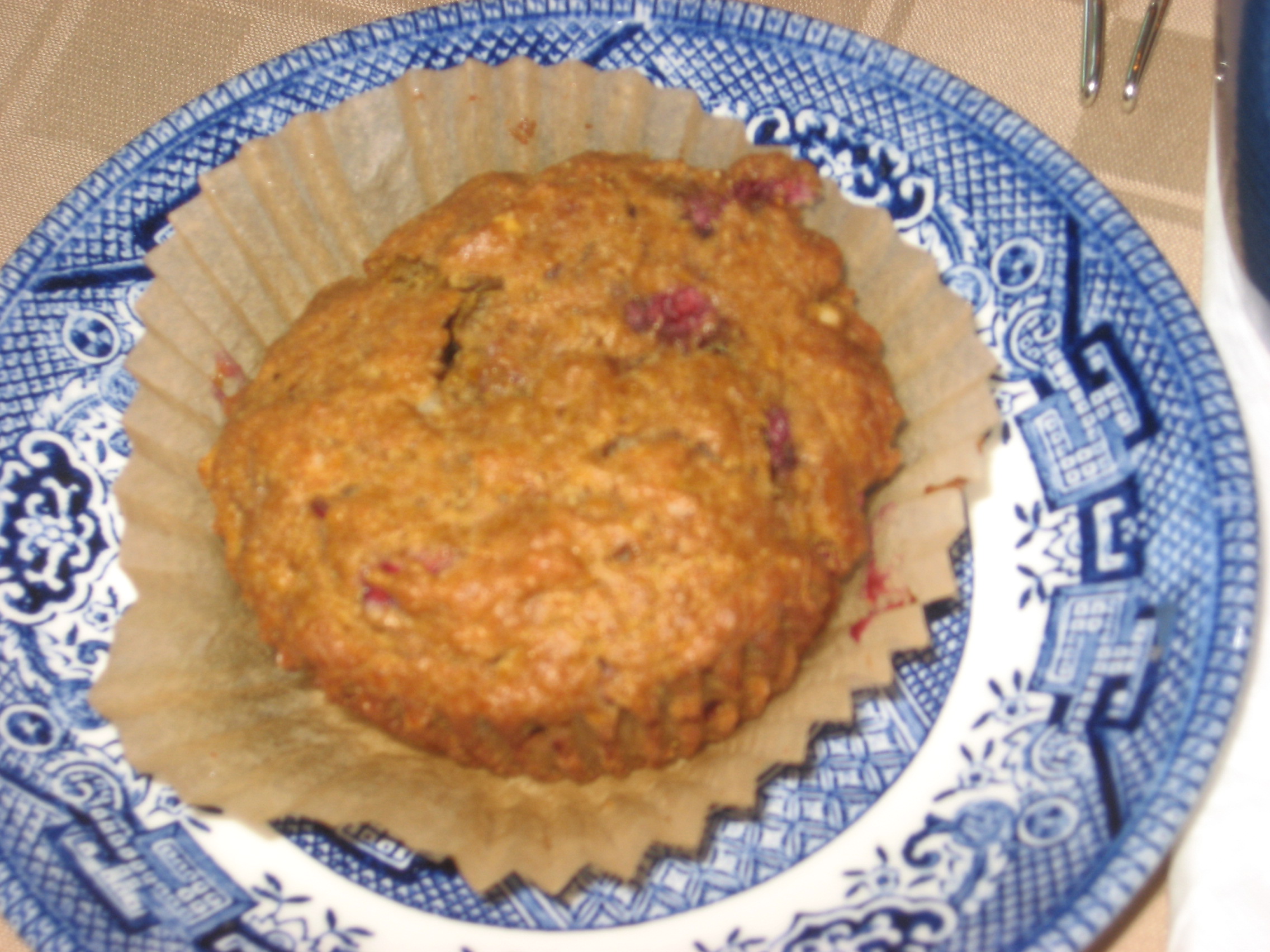
IMG_2029On a drive back from Asheville, my food and photography consultant Grace and I were discussing something new to do with muffins, or something new to do with rhubarb, or both–I’m not quite sure which. Either way, it was a lively discussion, and this recipe is the result.


Ingredients:

  • 2 cups flour (Whole wheat, white, both, as you wish)
  • ¾ cup of sugar
  • 2 tsp baking soda
  • ½ tsp cardamom
  • ½ tsp salt
  • ½ cup brown sugar
  • 1 cup diced rhubarb
  • 1 cup chopped fresh strawberries
  • ½ cup rolled oats
  • ½ cup walnuts
  • 2 cup cooked sweet potato (I like it baked, but I assume canned will do)
  • 3 eggs
  • ½ cup buttermilk or Greek yoghurt
  • ½ cup oil (it might work without this; I liked making it with coconut oil.)
  • 2 tsp. vanilla
  • ½ cup brewer’s yeast (optional)


Step 1, Prepare Ye the way: Preheat the oven to 350°, chop the rhubarb and the strawberries, either grease the muffin tins or put in the cupcake liners (I usually spray a little canola oil in the bottom of these to make things come out easier). I get 2 dozen medium sized muffins out of this mix.

Step 2, sifting the dry ingredients: In one bowl crumble up the brown sugar, then sift (mix if you don’t have a sifter) in the flour, white sugar, baking soda, cardamom, and salt. Mix thoroughly.

Step 3, mixing the wet ingredients: In another bowl, mix the oatmeal, rhubarb, strawberries, walnuts, sweet potato, eggs, buttermilk, oil, and vanilla.

Step 4, combining the big mess: Add the dry ingredients to the wet ones and mix well. You want to make sure the individual bits rhubarb & berry are each coated to keep them from getting too clumpy. The consistency should be much firmer than batter, but a little more liquid than cookie dough.IMG_2026

Step 5, baking: Fill two dozen or so muffin tins. Bake at 350 degrees for 30 minutes. See how they look. Stick a toothpick in one and see if it comes out battery.

Step 6, sharing: I think that muffins are an ideal sharing food. Sure, they are a great breakfast to hand to a family member as she rushes out the door, late for work, but they are even better to share for a liesurely breakfast with black coffee or strong tea sweetened by conversation. Of course, they work just as well for an afternoon tea. As always, they are a great gift to share at work, or to mail, or otherwise sneak to lovely people.(Note: if your only means of postage is messages in old bottles, they are a bit awkward.)

A Guide to Philosophers Here at the Bistro

After Wode Toad locked him out of the building last week, Chef Robert got a little behind schedule and asked me to pick up some of the slack. He tasked me with putting together a guide to some of the Philosophers we serve here at the Bistro. Customers have been asking, for instance, what Philosopher goes best with a wine spritzer. Especially because we’re so eclectic in the ingredients we use – insisting only that our Philosophers be organic and free of blue mold – we thought this guide would be a big help. Here’s the first installment:

We especially seek out Philosophers whose heads can also be used as sundials.

  • Name: Socrates. Just Socrates.
  • Qualities: Refined and classic, with a mild hemlock aftertaste.
  • Pair with: Rationality, questioning authority, figs.

Some commentators have expressed surprise at Hegel’s fondness for metaphors involving owls. They haven’t studies this picture.

  • Name: Georg Wilhelm Friedrich Hegel (in the American South he would have been called Billy Fred).
  • Qualities: Thick and hard to cut, like a well aged cheese, alleged to induce Naziism.
  • Pair with: Any counter-fascist agent, sardines.

 Portrait of Cousin It as a Young Man.

  • Name: Friedrich Nietzsche
  • Qualities: Literary styling, anti-rationalism, alleged to induce Naziism.
  • Pair with: Penicillin.

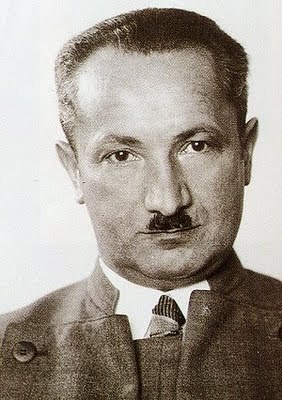
Only Charlie Chaplain could make that mustache work.

  • Name: Martin Heidegger
  • Qualities: A crisp, authentic taste. Actual Naziism – no allegations necessary.
  • Pair with: Atonement, Pepto Bismol.

  • Name: Hannah Arendt
  • Qualities: Diagnosing totalitarianism, never banal.
  • Pair with: Chateau Le Pin Pomerol 1999. (We’re usually out. Try the spritzer!)

Ah! The teeths. They burns us. 

  • Name: Joel Osteen
  • Qualities: Perky, hair can also be used as scouring pad.
  • Pair with: Prosperity gospel, brylcreem.

Putting the deep in Deepak since sometime a little after 1947.

  • Name: Deepak Choprah
  • Qualities: The warm feeling you get from a little too much wine or just before you freeze to death.
  • Pair with: Discontinued – too many customers thought they were ordering the Tupac (exactly as NSFW as you would probably expect).

Photo credits: Some Greek dude,  probably some German dude, some romantic dude – most likely a Czech or something, you gotta think some Nazi, right?, almost surely a beatnik, I’m guessing Deepak.

Turing, Touring, Turn, Turn, Turn.

One of the most important ideas of the 20th Century came from a rather odd but terribly brilliant man, the Cambridge Mathematician and Philosopher Alan Turing.WT brownies2

Normally, I would spend a few minutes telling you stories about Turing, but Wode Toad is holding a tray of brownies with peanut butter cream frosting hostage. (Thanks, Jodie—we stand in awe to your magical skills. The lemon bars last month were great, too)

The problem this mathematician was facing was how to design a machine that could answer your mathematical questions. His solution was to rethink the problem. Most of us would have thought of trying to program answers into the machine, so that you had a huge number of answers like “2+2=4.”
The problem is that the amount of information to be programmed in is not just huge, it’s prohibitive.

TuringIn a paper “On Computable Numbers, with an Application to the Entscheidungs problem,” Turing rethought the problem. Imagine a movable machine and a long line of squares laid out on paper strip. We call this imaginary device a Turing Machine. Put the machine at the second square, and teach it that “+2” mean to travel two squares, which put it at the fourth. Put another way, what the machine needs to know is not that “2+2=4,” but that if it is on second and somebody yells “Plus Two!” it needs to hustle two spaces, which puts it on the four.
If, instead of the infinite line of squares, we can allow the machine to have an astronomically high number of binary combinations, we have the basis of modern computing.

The key here is this: don’t think of the machine as knowing an infinite amount of little things; it only needs to know one thing, one very important thing.
It needs to know what to do next.

At roughly the same time and the same place, the philosopher WittgensteinLudwig Wittgenstein applied a similar idea to how language works. Languages are not logical representational structures; to use a language is to understand that when Wode Toad mutters “Order Up,” my response should be to finish the presentation (he ignores that) and get it to one of our guests.
What I need to know is what to do next.

This week, I have discovered that this fundamental question seems to be vexing a large number of my close friends, and the Bistro’s staff and patrons, and seems to be at the core of my own perplexity. What to do next?

Passage DifficileOur world keeps changing, and all the plans and dreams we thought we have keep shifting. Everybody I know seems to be either at the beginning of adulthood looking for how to start or in the middle looking to start anew. The ground beneath our feet, the markets and workplaces, even the professions themselves seem to be at least shifting, and possibly evaporating. This next week, a brand new crop of graduates will be cast out into the world (geworfenheit, where there is wailing and gnashing of teeth).
The challenge is knowing what to do next.

We are all in the uncomfortable position of knowing we must move, Shakespeare & Co stairsbut not knowing to where. We found ourselves thrown, but are still figuring out where to go, perhaps even still spinning and trying to figure out which direction to stand up. If we knew what we wanted, we might be able to figure out how to get there, but we don’t even know that.

At this point in my weekly entrée, I wish I had an answer to neatly tie this up, serve you dessert and coffee, and send you back into the night like the proverbial existentialist sparrow.

I wish I did.

I do not.

At best, I have two observations.

Remember that there is the dream and there is the plan.
The dream is not the plan, but may shape it. Since the plan may or may not fail, you had might as well make the dream big. The dream will tell you what you want, so don’t be a Jeff-says-I-can’t with your dreams. Plans will always be cut down to size by the actual circumstances, reality will force you to improvise, so don’t begin by cutting the dream down to size.
Let it be grand and glorious and very much you.

You don’t need to have figured out everything, just what to do next.

…and if you can’t figure out what’s next, sometimes if you just start you will figure out where you are going before you get there.
It’s how I got to the Philosophy Bistro.

We don’t know how Wode Toad got here; I think he is a fugitive from something, but is quite vague. He also denies having manipulated the Asian currency markets, whatever that means.

Myself, I haven’t figuredRoan Mountain Walk 013 out the next step. I seem to have become boxed in a dead-end, or rather trapped like a wolf in a pit. So, I have decided to take a step back. This summer, I will be backtracking to the city I lived in for a big chunk of the 70s, Tübingen in Germany. Once upon a time, I assumed that I would either live there or in New York or London. Maybe the open road will give me an idea of where I am going before I get there.

One dream I have accomplished though, I managed to become who I 44signatuream, and I have had the good luck to be,  your affectionate friend,

White Bean and Rosemary Dip

White Bean DipMy daughter acquired this recipe while staying at and working with the community at Koinonia Farms in Americus Georgia. They are a wonderful group of people, and also grow great pecans.


Ingredients:

  • ¼ cup olive oil
  • 1 large onion, chopped
  • 4 cloves garlic, peeled and minced
  • 2 cans (15 oz. each) white beans (Great Northern, cannellini, or white kidney beans) or the equivalent of dried cooked and drained.
  • 2 tsp salt
  • 3 sprigs fresh rosemary, rinsed
  • 2 large or 3 small tomatoes, chopped
  • Basalmic vinegar and freshly ground pepper to taste


Step 1, in the beginning: All origin stories should begin with olive oil, onions and garlic. Heat the olive oil sauté the onions until semi-translucent, add the garlic and rosemary and sauté until fragrant, being careful not to brown garlic, about 1 minute.

Step 2, the dip thickens: Add white beans and warm and soften them through. Add the salt and balsamic vinegar and mash the mixture to get it somewhat smooth.

Step 3, finishing: Remove from heat, the tomatoes and more balsamic, salt or pepper to taste. Garnish with rosemary sprigs.

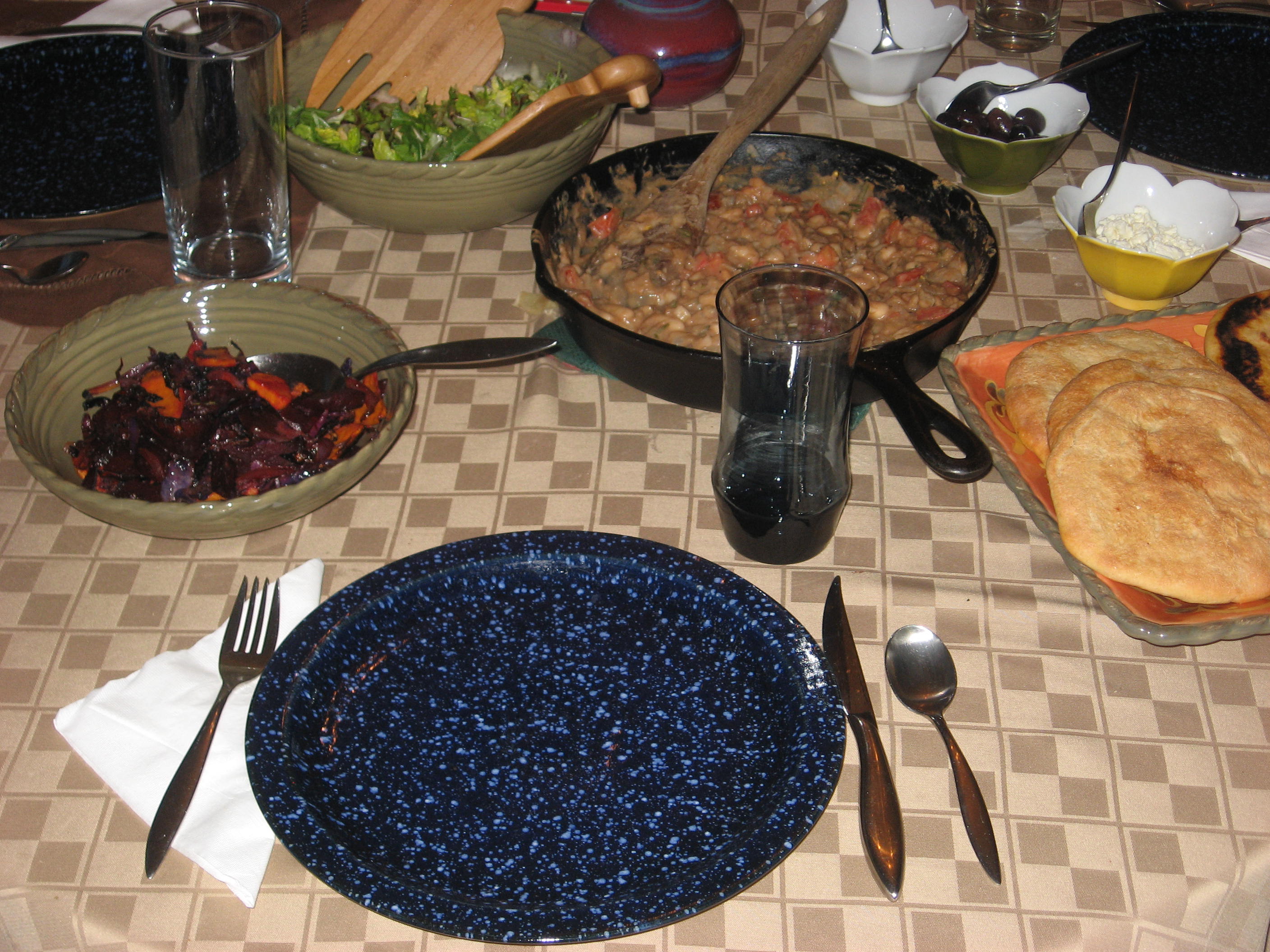
Step 4, to the table: Serve to friends, preferably on the terrace IMG_2019or in the garden, with pita chips and a fine chilled white wine. We served it with home made pita vread (forthcoming recipe), my roasted beet salad (also forthcoming), and a green salad.

Kant and the Manipulative Middle Manager

My first week here at the Philosophy Bistro has gone well. I get my meals free, the witticisms are frequently both complimentary and complementary, and whenever someone complains about my service, they at least start off by saying, “Bless his heart.” My only concern is that Wode Toad was in charge of my orientation, and I have not always found his instructions easy to follow. For example, he spent about fifteen minutes explaining that I must starch my shirts so that their collars are “stiff” without being “rigid,” and I have found this a fine line to tightrope across. Still I try my best, in part because I love the work, and in part because I can tell that the management is generally beneficent even when inscrutable.


“What have I told you about overdoing the chlorine?”

I cover all of my first week at the bistro in more detail in my epic “Ode on a Wode Toad,” but this is not yet ready for publication. (I made the mistake of writing the first draft in Gaelic, a language that I know mainly from Scrooge McDuck cartoons, and this has complicated my translation efforts.) Rather than drilling down further into my own experience, however, the way an artist might, I would like to step back and abstract from that experience as a Philosopher would. As an aid to this abstraction, let’s consider another case.

A good friend – we will call him “Rosebud” – recently told me he had called a meeting with another manager at his workplace for the first time in several months. For a long time they met regularly, at Rosebud’s invitation, but during the crunch period of a major, year-long project he ceased to find the time. Now that things had settled down he wanted to check in again, but the other manager’s first response had been to ask in a worried tone what the meeting was about. As we talked further, I began to see that these two probably had divergent expectations about their session. Rosebud understood that he had taken the responsibility earlier for establishing a good relationship with his co-worker, he had gotten too busy to keep meeting with her, she had not taken steps to continue those meetings, and their work together had suffered some as a result. He wanted to clear the air without blaming anyone, while inviting both of them to do better in the future. The other manager, I sensed, might have taken for granted Rosebud’s early initiative to bring them together, felt ignored or abandoned when he stopped calling meetings, and decided that if there was any blame to go around, it should not go to her. This was only a guess on my part, but it seemed a good way to make sense of Rosebud’s story. When it came time for me to offer advice, I made two suggestions: (1) Forget the past and just focus on the future, and (2) Stress the positive, including giving any praise that you sincerely can. Rosebud understood how the first suggestion could reduce defensiveness and avoid the kind of deep processing that he appreciates but his co-worker might now. And he generally agreed with the second suggestion too, but worried that it would be manipulative.

Since this discussion I’ve thought a lot about management and manipulation. In my own years managing people I never really reached a settled position on this topic. In part, I blame Immanuel Kant.

Everything you say seems more erudite when you’re wearing a powdered wig.

Kant, you see, is almost without question the leading ethical thinker in the Western Philosophical tradition, certainly as judged by his reputation among contemporary Philosophers. He is the leading theorist of autonomy – the right of each individual to make their own informed decisions – and so the arch-enemy of even the most well-meaning manipulation. You must never, according to Kant, use other people as a means to your own ends, but must instead engage with respect for their innate ability to decide their own goals. Over the decade I spent in college and graduate school, I can recall only a few ethical debates where Kantian arguments did not play a significant part, and only slightly fewer where Kant did not have the last say. Individual autonomy is essential our overwhelmingly liberal culture. (I mean “liberal” in a slightly broader sense than it’s usually used, and that’s a discussion that will have to wait for another day.) And I grew to appreciate and largely adopt this position for my own. I made something like a vow to myself that I would always try to treat people as ends-in-themselves, to avoid manipulating them, even in a sincere effort to help them, and instead to give them the information they need to make their own decisions.

And then I started managing people. And then I became a (step-)parent. And I wonder what Kant would have made of either experience. I certainly don’t think there will ever be a Kantian Guide for Raising Autonomous Children, and we have yet to see a book with a title like Kantian Leadership in the Boardroom. The latter is surprising, because the still burgeoning world of business books keeps churning out management guides based on the lives of considerably less admirable figures, Attila the Hun and Genghis Khan among them. (For those in a rush, here is a brief summary of the lessons from Genghis Khan’s career: gather the nomads, make sure you’ve invented stirrups so that they can fire their arrows forward or backward while riding at a full gallop, and avoid southern China like the plague, because that’s where the plague comes from. Also, if you see someone with either of these books on their desk, walk away.) There have even been books that draw on other ethical thinkers. But Kant just does not lend himself well to such application.

It took me a while to figure out why. And while managing adults helped me learn this lesson, it’s been helping raise young twin daughters that has really let me understand: before people can hear you, they have to trust you. Kant, like most Philosophers, treats language as it consisted mainly of statements exchanged between people dispassionately contemplating the world. But that is not usually so. Take the sentence, “You could have done that better.” We can analyze its truth conditions and find that it is almost surely true. You – whoever you are – could almost surely have done that – whatever it is – better by some reasonable standard. This is the typical way Philosophers study language. But it’s not how most people, including Philosophers, actually use language most of the time. If someone you trust tells you that you could have done better, you know they have your best interests at heart and think it’s important for you to be encouraged to improve. (I make variations of this statement to my step-daughters almost daily, and increasingly they say it back.) By comparison, if someone you’ve come to see as your enemy says the same thing, you’re more likely to think they are trying to undermine you. And you may be right.

People warned me when I first began managing some of my fellow faculty members that all of my professional relationships would change. I didn’t believe them. Or rather, I believed that that could happen, but I thought it all depended on how I carried myself. If I still treated people the same way, we would have the same relationship. But that wasn’t true. The same words had different meaning when they came from “the boss.” I anticipated that I would have to stop making fun of my close friends, and that they would probably make fun of me less, at least when I was around. But I didn’t get that everything I said and didn’t say would be scrutinized for possible threats. I didn’t realize that the (honestly, rather limited) power I had in this new position meant that people I had known for years were going to have to learn to trust me in this new role, and that without that trust they honestly would not be able to understand me the same way any more.

Here’s where Kant really got me into trouble. I kept trying to give people information and let them make their own decision rather than manipulating them into what I thought was the right decision, whether on my terms or what I took for their own. And this had worked for me as a teacher and as a colleague. I think one of the reasons I got elected to an administrative position in the first place was that people found me collegial in precisely this way. But when I did the same thing as a manager, people were confused. I believe that some thought I was trying hardest to manipulate them when I was trying hardest not to. It took me a while to hear how they must be hearing me when I said things like, “That decision needs to be yours, and I respect whatever decision you make.” I imagine that if you’re in the certain percentage of the population that has not had a relationship with a supervisor like the kind I was inviting, such statements seem particularly sinister.

If I were starting administration all over again, I would pay more attention to earning people’s trust from the beginning. You’re never going to get everyone – disliking the boss is just too fun and too well ingrained at most institutions, often for good reason. But parenting has hammered in how essential it is to earn trust at the outset. Once you’ve got it, even difficult conversations become easier. And if you don’t have it, even exchanges you think will be easy can be fraught.

So that’s why I encourage Rosebud to let his Kantianism go just this once and to risk feeling a little manipulative in an attempt to build trust with his co-worker. And that’s also why I so appreciate it when Wode Toad begins by saying, “Bless your heart,” even when he continues with, “You’re as dumb as a bag of hammers, aren’t you?” It tells me that my amphibian overlord cares for me and wants me to understand that. I’m guessing that he reads a lot of Aristotle.

Picture credit: Robert Shields, Wikicommons.